Latest Cisco, PMP, AWS, CompTIA, Microsoft Materials on SALE Get Now Get Now
Home/
Blog/
Demystifying the Cloud Blueprint: How to Pass the AWS Solutions Architect Associate (SAA-C03) Exam in 2026
SPOTO 2 2026-06-29 10:54:20
Demystifying the Cloud Blueprint: How to Pass the AWS Solutions Architect Associate (SAA-C03) Exam in 2026

The era of obtaining cloud certifications merely to pad one's resume is long gone. Engineering managers and enterprise clients no longer care if you can recite the names of a few managed services or launch a basic virtual machine via the management console. In today's landscape—characterized by complex hybrid architectures, modern serverless operational models, and strict budget constraints—the focus has shifted entirely to practical implementation capabilities. Enterprises need professionals capable of designing robust architectures: systems that won't crash during sudden traffic spikes, expose sensitive corporate databases to the public internet, or rack up thousands of dollars in unnecessary compute costs overnight.

It is precisely this shift in operational philosophy that keeps the AWS Certified Solutions Architect – Associate (SAA-C03) certification the "gold standard" for validating cloud engineering proficiency. The SAA-C03 exam is far from a simple test of rote memorization; it is a rigorous assessment of engineering competence based on the AWS Well-Architected Framework. To pass, you must move beyond viewing AWS services as isolated tools and instead see them as components of an interconnected, production-ready system.


1. Evaluating the Matrix: SAA-C03 Testing Parameters

Before you map out your study schedule, you need to understand the exact structure of the testing center matrix.

The SAA-C03 exam lasts 130 minutes and consists of 65 multiple-choice questions.

Out of these 65 items, exactly 50 are actively scored to calculate your results, while 15 are unscored experimental variations scattered throughout the test to evaluate potential questions for future syllabus updates. AWS does not tag these experimental items, meaning you must approach every single scenario with the same level of analytical focus. Your performance is translated into a scaled scoring model ranging from 100 to 1,000 points. To secure your credential, you must achieve a minimum passing threshold of 720.


2. Technical Core: Deconstructing the Four Essential Domains

The active SAA-C03 blueprint splits its architectural evaluation across four critical conceptual pillars. Each pillar forces you to make complex trade-offs based on changing operational parameters.

(1) Design Secure Architectures (30%)

This is the single heaviest section of the exam and the most frequent point of failure for underprepared candidates. AWS approaches infrastructure security through a layered defense model, and you must know how to enforce isolation at every single boundary.

You will face deep scenario evaluations tracking AWS Identity and Access Management (IAM) strategies. You must master the construction of complex identity policies, knowing exactly when to assign role-based credentials over long-lived IAM user keys, and how to control access across multiple organizational accounts using Service Control Policies (SCPs) within AWS Organizations.

At the network layer, expect to parse detailed configurations within an Amazon Virtual Private Cloud (VPC). You need to fully understand how Security Groups act as stateful firewalls at the instance level, how Network Access Control Lists (NACLs) serve as stateless boundary controls at the subnet tier, and how to route traffic securely using public subnets, private subnets, and NAT gateways. Additionally, you will be evaluated on data encryption lifecycle parameters, requiring full competence in configuring server-side encryption (SSE) using AWS Key Management Service (KMS) keys, implementing envelope encryption, and deploying edge defense via AWS WAF and AWS Shield to block distributed denial-of-service (DDoS) vectors.

(2) Design Resilient Architectures (26%)

Resiliency in AWS is rooted in eliminating single points of failure. This domain tests your ability to build self-healing environments that absorb physical hardware drops, network drops, or software anomalies without interrupting production services.

The backbone of this section centers on automated scaling patterns. You must know how to couple Auto Scaling groups with Elastic Load Balancing (ELB) mechanisms, choosing Application Load Balancers (ALBs) for HTTP/HTTPS layer-7 routing adjustments or Network Load Balancers (NLBs) for ultra-low latency layer-4 performance.

You need to know how to distribute resources across multiple Availability Zones (Multi-AZ) to protect against facility outages, and how to manage global traffic failover using Amazon Route 53 routing profiles like geolocation, latency-based, or failover policies. A major technical theme here is the shift from tightly coupled setups to asynchronous architectures. You must show how to break up rigid application links using Amazon Simple Queue Service (SQS) to queue messages, Amazon Simple Notification Service (SNS) for fan-out messaging alerts, and Amazon EventBridge to orchestrate decoupled microservices.

(3) Design High-Performing Architectures (24%)

High performance is about matching the exact processing characteristics of an enterprise workload to the appropriate underlying infrastructure tier.

For computing needs, you must show deep familiarity with Amazon Elastic Compute Cloud (EC2) configuration profiles, choosing compute-optimized, memory-optimized, or storage-optimized instances based on real-world application demands. The exam challenges your ability to differentiate storage solutions, specifically measuring your knowledge of Amazon Elastic Block Store (EBS) performance tiers like General Purpose SSDs (gp3) versus Provisioned IOPS (io2), alongside the shared file system capabilities of Amazon Elastic File System (EFS).

Database selection requires strict architectural precision. You must know when a relational engine like Amazon RDS or Amazon Aurora is required to guarantee strict transactional compliance, versus when an enterprise should pivot to the single-digit millisecond latency of a NoSQL engine like Amazon DynamoDB. To pass these sections, you should also understand caching layers, knowing how to implement Amazon ElastiCache to offload database read burdens and how to position Amazon CloudFront edge distributions to accelerate global content delivery pipelines.

(4)Design Cost-Optimized Architectures (20%)

An architect who designs a highly performant system that drains a company's budget has ultimately failed. This domain tests your capacity to squeeze the absolute maximum value out of every cloud dollar spent.

You must demonstrate total clarity regarding compute purchasing variants. This means selecting On-Demand instances exclusively for short-term, erratic testing environments; committing to Savings Plans or Reserved Instances for predictable, long-running operational baselines; and leveraging Spot Instances to secure up to a 90% discount for fault-tolerant, interruptible batch processing jobs.

Storage optimization requires a fluid understanding of Amazon S3 lifecycle rules. You will need to build automation frameworks that transition old data objects seamlessly through diverse storage tiers, moving from S3 Standard to S3 Standard-Infrequent Access, down to S3 Glacier Flexible Retrieval or Deep Archive as data aging policies evolve. You will also face troubleshooting scenarios focused on right-sizing infrastructure—identifying over-provisioned components through AWS Cost Explorer and terminating idle NAT Gateways or orphaned EBS volumes to maintain a lean deployment footprint.


3. Deconstructing the Blueprint: Spotting Distractor Logic

The true secret to cracking the SAA-C03 exam lies in learning how to isolate the primary constraint inside the problem statement. AWS intentionally builds question prompts where multiple answers are technically functional within a real console environment, but only one option aligns perfectly with the explicit criteria highlighted in the prompt.

When a scenario requests a solution that is "most cost-effective," any option recommending Provisioned IOPS storage or high-availability Multi-AZ configurations for non-critical developer labs are an immediate structural distractor. Conversely, if the prompt uses words like "maximum performance" or "lowest possible latency," cost-cutting options are instantly disqualified. Always scan the prompt for keywords such as operational overhead, real-time, or durability, and use those markers to eliminate choices that violate that specific architectural priority.


4. Beyond the Documentation: Operationalizing Your Practice

Because the current AWS testing pool places such an immense focus on complex scenario logic and multifaceted service combinations, you cannot clear the 720-point passing score through passive video observation or textbook skimming alone. True readiness requires building technical pattern recognition—knowing exactly how services interact under pressure and immediately spotting configuration anomalies.

When you are ready to move out of the passive reading loop and systematically test your engineering judgment against true exam parameters, incorporating realistic practice environments is an indispensable step. SPOTO offers highly accurate SAA-C03 exam simulations, up-to-date question matrices, and comprehensive review modules engineered to match the depth and tone of the official AWS Associate blueprint. By using these targeted validation tools to hone your question parsing speed, build your testing stamina, and isolate your conceptual blind spots in VPC networking or IAM policy construction before your official proctored testing window begins, you can enter the certification center with complete strategic confidence and pass your exam on your very first try.
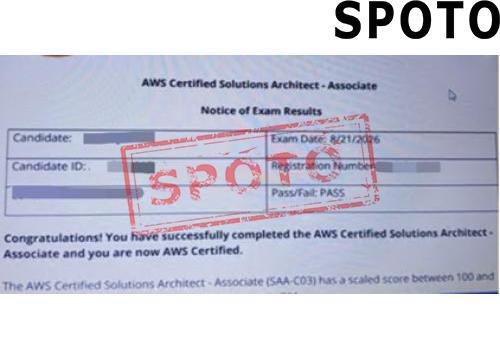
 

Latest Passing Reports from SPOTO Candidates
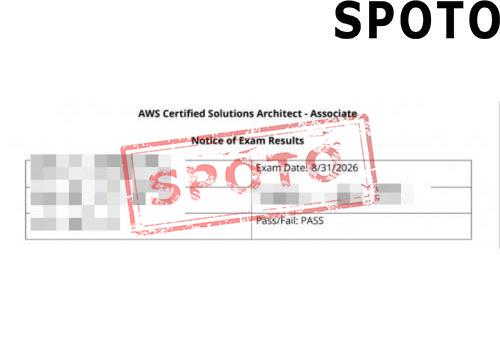
SAA-C03-P

SAA-C03-P

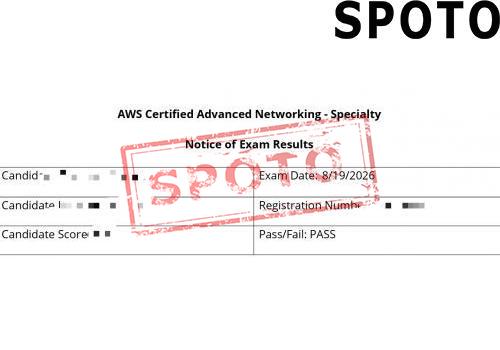
ANS-C01

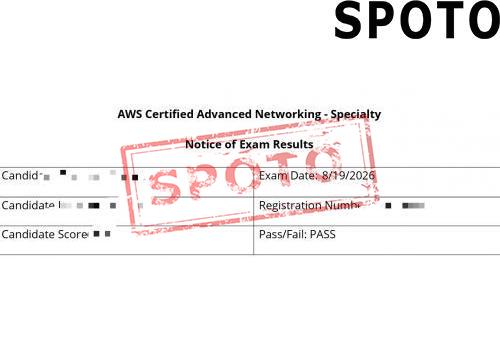
ANS-C01

CLF-C02-P

CLF-C02-P

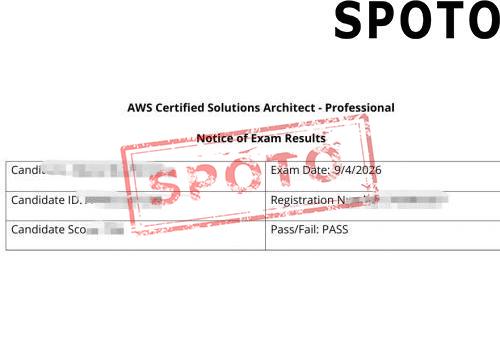
SAP-C02-P

SAP-C02-P

SAP-C02

SAP-C02

SAP-C02

SAP-C02

CLF-C02-P

CLF-C02-P

CLF-C02-P

CLF-C02-P

CLF-C02-P

CLF-C02-P

DVA-C02-P

DVA-C02-P

Write a Reply or Comment
Home/Blog/Demystifying the Cloud Blueprint: How to Pass the AWS Solutions Architect Associate (SAA-C03) Exam in 2026
Demystifying the Cloud Blueprint: How to Pass the AWS Solutions Architect Associate (SAA-C03) Exam in 2026
SPOTO 2 2026-06-29 10:54:20
Demystifying the Cloud Blueprint: How to Pass the AWS Solutions Architect Associate (SAA-C03) Exam in 2026

The era of obtaining cloud certifications merely to pad one's resume is long gone. Engineering managers and enterprise clients no longer care if you can recite the names of a few managed services or launch a basic virtual machine via the management console. In today's landscape—characterized by complex hybrid architectures, modern serverless operational models, and strict budget constraints—the focus has shifted entirely to practical implementation capabilities. Enterprises need professionals capable of designing robust architectures: systems that won't crash during sudden traffic spikes, expose sensitive corporate databases to the public internet, or rack up thousands of dollars in unnecessary compute costs overnight.

It is precisely this shift in operational philosophy that keeps the AWS Certified Solutions Architect – Associate (SAA-C03) certification the "gold standard" for validating cloud engineering proficiency. The SAA-C03 exam is far from a simple test of rote memorization; it is a rigorous assessment of engineering competence based on the AWS Well-Architected Framework. To pass, you must move beyond viewing AWS services as isolated tools and instead see them as components of an interconnected, production-ready system.


1. Evaluating the Matrix: SAA-C03 Testing Parameters

Before you map out your study schedule, you need to understand the exact structure of the testing center matrix.

The SAA-C03 exam lasts 130 minutes and consists of 65 multiple-choice questions.

Out of these 65 items, exactly 50 are actively scored to calculate your results, while 15 are unscored experimental variations scattered throughout the test to evaluate potential questions for future syllabus updates. AWS does not tag these experimental items, meaning you must approach every single scenario with the same level of analytical focus. Your performance is translated into a scaled scoring model ranging from 100 to 1,000 points. To secure your credential, you must achieve a minimum passing threshold of 720.


2. Technical Core: Deconstructing the Four Essential Domains

The active SAA-C03 blueprint splits its architectural evaluation across four critical conceptual pillars. Each pillar forces you to make complex trade-offs based on changing operational parameters.

(1) Design Secure Architectures (30%)

This is the single heaviest section of the exam and the most frequent point of failure for underprepared candidates. AWS approaches infrastructure security through a layered defense model, and you must know how to enforce isolation at every single boundary.

You will face deep scenario evaluations tracking AWS Identity and Access Management (IAM) strategies. You must master the construction of complex identity policies, knowing exactly when to assign role-based credentials over long-lived IAM user keys, and how to control access across multiple organizational accounts using Service Control Policies (SCPs) within AWS Organizations.

At the network layer, expect to parse detailed configurations within an Amazon Virtual Private Cloud (VPC). You need to fully understand how Security Groups act as stateful firewalls at the instance level, how Network Access Control Lists (NACLs) serve as stateless boundary controls at the subnet tier, and how to route traffic securely using public subnets, private subnets, and NAT gateways. Additionally, you will be evaluated on data encryption lifecycle parameters, requiring full competence in configuring server-side encryption (SSE) using AWS Key Management Service (KMS) keys, implementing envelope encryption, and deploying edge defense via AWS WAF and AWS Shield to block distributed denial-of-service (DDoS) vectors.

(2) Design Resilient Architectures (26%)

Resiliency in AWS is rooted in eliminating single points of failure. This domain tests your ability to build self-healing environments that absorb physical hardware drops, network drops, or software anomalies without interrupting production services.

The backbone of this section centers on automated scaling patterns. You must know how to couple Auto Scaling groups with Elastic Load Balancing (ELB) mechanisms, choosing Application Load Balancers (ALBs) for HTTP/HTTPS layer-7 routing adjustments or Network Load Balancers (NLBs) for ultra-low latency layer-4 performance.

You need to know how to distribute resources across multiple Availability Zones (Multi-AZ) to protect against facility outages, and how to manage global traffic failover using Amazon Route 53 routing profiles like geolocation, latency-based, or failover policies. A major technical theme here is the shift from tightly coupled setups to asynchronous architectures. You must show how to break up rigid application links using Amazon Simple Queue Service (SQS) to queue messages, Amazon Simple Notification Service (SNS) for fan-out messaging alerts, and Amazon EventBridge to orchestrate decoupled microservices.

(3) Design High-Performing Architectures (24%)

High performance is about matching the exact processing characteristics of an enterprise workload to the appropriate underlying infrastructure tier.

For computing needs, you must show deep familiarity with Amazon Elastic Compute Cloud (EC2) configuration profiles, choosing compute-optimized, memory-optimized, or storage-optimized instances based on real-world application demands. The exam challenges your ability to differentiate storage solutions, specifically measuring your knowledge of Amazon Elastic Block Store (EBS) performance tiers like General Purpose SSDs (gp3) versus Provisioned IOPS (io2), alongside the shared file system capabilities of Amazon Elastic File System (EFS).

Database selection requires strict architectural precision. You must know when a relational engine like Amazon RDS or Amazon Aurora is required to guarantee strict transactional compliance, versus when an enterprise should pivot to the single-digit millisecond latency of a NoSQL engine like Amazon DynamoDB. To pass these sections, you should also understand caching layers, knowing how to implement Amazon ElastiCache to offload database read burdens and how to position Amazon CloudFront edge distributions to accelerate global content delivery pipelines.

(4)Design Cost-Optimized Architectures (20%)

An architect who designs a highly performant system that drains a company's budget has ultimately failed. This domain tests your capacity to squeeze the absolute maximum value out of every cloud dollar spent.

You must demonstrate total clarity regarding compute purchasing variants. This means selecting On-Demand instances exclusively for short-term, erratic testing environments; committing to Savings Plans or Reserved Instances for predictable, long-running operational baselines; and leveraging Spot Instances to secure up to a 90% discount for fault-tolerant, interruptible batch processing jobs.

Storage optimization requires a fluid understanding of Amazon S3 lifecycle rules. You will need to build automation frameworks that transition old data objects seamlessly through diverse storage tiers, moving from S3 Standard to S3 Standard-Infrequent Access, down to S3 Glacier Flexible Retrieval or Deep Archive as data aging policies evolve. You will also face troubleshooting scenarios focused on right-sizing infrastructure—identifying over-provisioned components through AWS Cost Explorer and terminating idle NAT Gateways or orphaned EBS volumes to maintain a lean deployment footprint.


3. Deconstructing the Blueprint: Spotting Distractor Logic

The true secret to cracking the SAA-C03 exam lies in learning how to isolate the primary constraint inside the problem statement. AWS intentionally builds question prompts where multiple answers are technically functional within a real console environment, but only one option aligns perfectly with the explicit criteria highlighted in the prompt.

When a scenario requests a solution that is "most cost-effective," any option recommending Provisioned IOPS storage or high-availability Multi-AZ configurations for non-critical developer labs are an immediate structural distractor. Conversely, if the prompt uses words like "maximum performance" or "lowest possible latency," cost-cutting options are instantly disqualified. Always scan the prompt for keywords such as operational overhead, real-time, or durability, and use those markers to eliminate choices that violate that specific architectural priority.


4. Beyond the Documentation: Operationalizing Your Practice

Because the current AWS testing pool places such an immense focus on complex scenario logic and multifaceted service combinations, you cannot clear the 720-point passing score through passive video observation or textbook skimming alone. True readiness requires building technical pattern recognition—knowing exactly how services interact under pressure and immediately spotting configuration anomalies.

When you are ready to move out of the passive reading loop and systematically test your engineering judgment against true exam parameters, incorporating realistic practice environments is an indispensable step. SPOTO offers highly accurate SAA-C03 exam simulations, up-to-date question matrices, and comprehensive review modules engineered to match the depth and tone of the official AWS Associate blueprint. By using these targeted validation tools to hone your question parsing speed, build your testing stamina, and isolate your conceptual blind spots in VPC networking or IAM policy construction before your official proctored testing window begins, you can enter the certification center with complete strategic confidence and pass your exam on your very first try.
 

Latest Passing Reports from SPOTO Candidates
SAA-C03-P
ANS-C01
CLF-C02-P
SAP-C02-P
SAP-C02
SAP-C02
CLF-C02-P
CLF-C02-P
CLF-C02-P
DVA-C02-P
Write a Reply or Comment
Don't Risk Your Certification Exam Success – Take Real Exam Questions
Eligible to sit for Exam? 100% Exam Pass GuaranteeEligible to sit for Exam? 100% Exam Pass Guarantee
SPOTO Ebooks
Recent Posts
Building the AI Factory: Is the NVIDIA NCA-AIIO Your Ticket into the Data Center?
Demystifying the Cloud Blueprint: How to Pass the AWS Solutions Architect Associate (SAA-C03) Exam in 2026
Beyond the Hype: Is the CCNP Still Worth Pursuing in 2026?
Scraping Past the Hype: What It Really Takes to Pass the NVIDIA NCA-GENL Exam
Is the CCNA outdated? The Real Truth About Choosing Your Networking Path in 2026
Details Determine Success or Failure: The Brutal Truth About Passing the NVIDIA NCP-AIN Certification Exam
Privacy by Design Certifications: An Overview of the Modern ISACA CDPSE Certification
Why ISACA CGEIT is the Ultimate Executive Milestone?
Why CRISC is the Smartest Tech Bet in 2026?
The Ultimate Guide to CCIE Data Center Lab Preparation: Pass on the First Attempt
Excellent
5.0
Based on 5236 reviews
Request more information
I would like to receive email communications about product & offerings from SPOTO & its Affiliates.
I understand I can unsubscribe at any time.