Latest Cisco, PMP, AWS, CompTIA, Microsoft Materials on SALE Get Now Get Now
Home/
Blog/
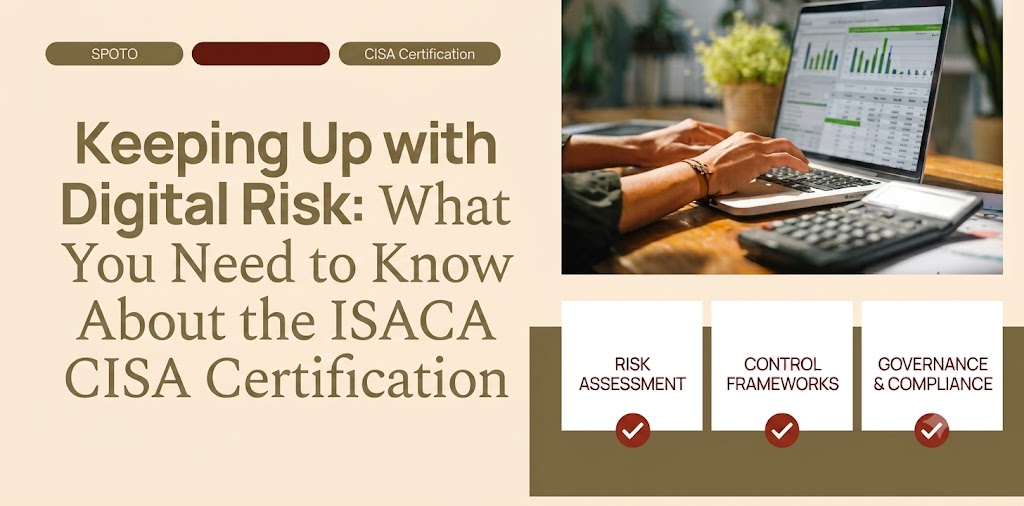
Keeping Up with Digital Risk: What You Need to Know About the ISACA CISA Certification
SPOTO 2 2026-07-27 10:34:38
Keeping Up with Digital Risk: What You Need to Know About the ISACA CISA Certification

As enterprise tech moves to the cloud and regulatory pressure keeps climbing, companies can't afford to treat IT auditing as an afterthought. It isn't just about ticking compliance boxes anymore. Boards and leadership teams need clear proof that their systems are secure, resilient, and operating without major blind spots.

That is where the Certified Information Systems Auditor (CISA) credential comes in. Administered by ISACA since 1978, CISA remains the go-to benchmark for professionals who evaluate, audit, and secure business technology systems.

Here is a practical, ground-level look at what the CISA certification covers, recent syllabus shifts, realistic salary expectations, and how to get certified.


1. What Is the ISACA CISA Certification?

The CISA is an advanced professional certification built specifically for people who audit, control, and monitor enterprise IT environments.

Unlike hands-on technical certifications that focus on configuring firewalls or writing code, CISA looks at technology through an audit and governance lens. It measures whether you know how to assess system design, verify internal controls, spot operational weaknesses, and present clear risk assessments to executive leadership and external regulators.


2. Why the CISA Qualification Holds Real Value

Holding the CISA credential signals to hiring teams that you know how to bridge the gap between technical operations and executive governance. A few clear benefits of holding the certification include:

Global recognition: The credential is recognized across financial services, public accounting, healthcare, and tech sectors in over 180 countries.

Bridge between tech and leadership: CISA holders know how to translate complex system logs and technical flaws into business risks that C-suite executives and board committees can actually act on.

Career progression: Major accounting firms, consulting agencies, and enterprise audit teams frequently require the CISA for promotion into senior auditor, manager, or director roles.

High demand for audit skills: With regulatory frameworks (like SOX, SOC 2, ISO 27001, and NIS2) growing more complex, organizations actively seek auditors who understand automated controls and cloud risk.


3. Exam Details, Blueprint Structure, and Recent Focus Areas

The CISA exam gives you 4 hours (240 minutes) to answer 150 multiple-choice questions. Scores are reported on a scaled range from 200 to 800, and you need 450 points to pass.

ISACA regularly updates the CISA exam objectives so the test mirrors how modern IT audit teams work today. Recent exam blueprints place a much stronger emphasis on cloud infrastructure, third-party vendor risks, automated controls, and business resilience. The test material breaks down into five core domains:

Domain 1: Information Systems Auditing Process (18%): Covers audit standards, risk-based planning, sampling methods, evidence gathering, data analytics tools, and writing clear audit reports.

Domain 2: Governance and Management of IT (18%): Focuses on IT governance frameworks, strategic alignment, organizational structures, policies, and enterprise risk management.

Domain 3: Information Systems Acquisition, Development, and Implementation (12%): Evaluates project governance, system development lifecycles (SDLC), testing protocols, migration risks, and post-implementation reviews.

Domain 4: Information Systems Operations and Business Resilience (26%): Tests operational controls, service delivery, incident management, backups, disaster recovery, and business continuity planning.

Domain 5: Protection of Information Assets (26%): Focuses on identity and access management, network security, data protection, encryption, and physical security controls.

Together, Domains 4 and 5 make up 52% of the total exam. This heavy weighting reflects what modern IT auditors face every day: evaluating cyber resilience, data privacy, and operational continuity in live cloud and hybrid environments.


4. Requirements to Get Certified

Getting the official CISA certification involves a straightforward three-step process:

(1) Pass the Exam

You must register for and pass the 150-question computer-based exam. Because CISA questions test how an auditor should evaluate a situation rather than basic definitions, passing requires strong scenario analysis. Practicing with realistic question banks—like the CISA study packages from SPOTO—helps you get used to ISACA's audit logic and learn how to manage your time during the 4-hour test.

(2) Verify 5 Years of Experience

You need to document at least 5 years of professional work experience in IS auditing, control, or security within the 10 years prior to your application. You can waive up to 2 years of this requirement if you hold a relevant degree (like a bachelor's or master's in IT/audit) or complementary certifications like CISM or CISSP.

(3) Maintain Your Credential

To keep your CISA active, you must follow ISACA's Code of Professional Ethics, pay an annual fee, and submit Continuing Professional Education (CPE) credits. You need at least 20 CPEs every year, totaling 120 CPEs over a three-year cycle.


5. Salary Potential and Career Outlook

Because skilled IT auditors who understand both technology and business risk are hard to come by, CISA holders enjoy strong compensation and stable job options.

While exact pay depends on your location and total years in the field, standard salary ranges for CISA-aligned roles include:

IT Auditor/Compliance Analyst: Entry to mid-level auditors typically earn base salaries between $85,000 and $110,000 per year.

Senior IT Auditor / Risk Advisory Consultant: Experienced auditors leading control testing, SOC audits, and risk reviews earn between $115,000 and $145,000.

IT Audit Director / Chief Audit Executive: Senior leaders managing enterprise audit teams and reporting directly to board committees command total packages ranging from $150,000 to $190,000+.


6. Related Certifications to Consider

Depending on whether you want to stick with auditing or branch out into risk management or security leadership, here are a few related certifications:

Certified Internal Auditor (CIA): Managed by the IIA, this covers broad financial and operational auditing rather than technical IT systems.

Certified in Risk and Information Systems Control (CRISC): Also from ISACA, this focuses specifically on enterprise risk identification, control design, and risk mitigation.

Certified Information Security Manager (CISM): An ISACA credential built for professionals who manage and design enterprise security programs rather than audit them.

Certified Information Systems Security Professional (CISSP): Managed by ISC2, this is a deep technical certification focused on security architecture, engineering, and operational defense.
 

Latest Passing Reports from SPOTO Candidates
ISACA-CISM-P

ISACA-CISM-P

ISACA-CISM-P

ISACA-CISM-P

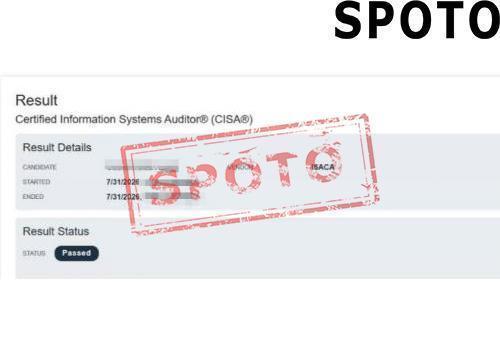
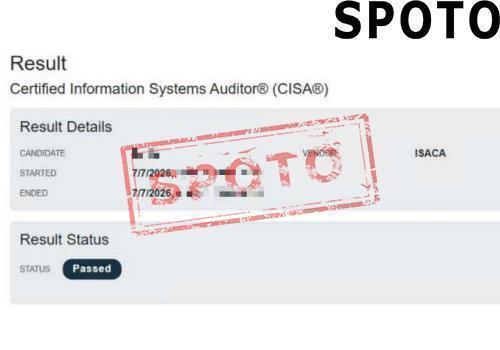
ISACA-CISA-P

ISACA-CISA-P

ISACA-CISA-P

ISACA-CISA-P

ISACA-CISM-P

ISACA-CISM-P

ISACA-CISM-P

ISACA-CISM-P

ISACA-CISA-P

ISACA-CISA-P

ISACA-CGEIT-P

ISACA-CGEIT-P

ISACA-CISM-P

ISACA-CISM-P

ISACA-CISM-P

ISACA-CISM-P

Write a Reply or Comment
Home/Blog/Keeping Up with Digital Risk: What You Need to Know About the ISACA CISA Certification
Keeping Up with Digital Risk: What You Need to Know About the ISACA CISA Certification
SPOTO 2 2026-07-27 10:34:38
Keeping Up with Digital Risk: What You Need to Know About the ISACA CISA Certification

As enterprise tech moves to the cloud and regulatory pressure keeps climbing, companies can't afford to treat IT auditing as an afterthought. It isn't just about ticking compliance boxes anymore. Boards and leadership teams need clear proof that their systems are secure, resilient, and operating without major blind spots.

That is where the Certified Information Systems Auditor (CISA) credential comes in. Administered by ISACA since 1978, CISA remains the go-to benchmark for professionals who evaluate, audit, and secure business technology systems.

Here is a practical, ground-level look at what the CISA certification covers, recent syllabus shifts, realistic salary expectations, and how to get certified.


1. What Is the ISACA CISA Certification?

The CISA is an advanced professional certification built specifically for people who audit, control, and monitor enterprise IT environments.

Unlike hands-on technical certifications that focus on configuring firewalls or writing code, CISA looks at technology through an audit and governance lens. It measures whether you know how to assess system design, verify internal controls, spot operational weaknesses, and present clear risk assessments to executive leadership and external regulators.


2. Why the CISA Qualification Holds Real Value

Holding the CISA credential signals to hiring teams that you know how to bridge the gap between technical operations and executive governance. A few clear benefits of holding the certification include:

Global recognition: The credential is recognized across financial services, public accounting, healthcare, and tech sectors in over 180 countries.

Bridge between tech and leadership: CISA holders know how to translate complex system logs and technical flaws into business risks that C-suite executives and board committees can actually act on.

Career progression: Major accounting firms, consulting agencies, and enterprise audit teams frequently require the CISA for promotion into senior auditor, manager, or director roles.

High demand for audit skills: With regulatory frameworks (like SOX, SOC 2, ISO 27001, and NIS2) growing more complex, organizations actively seek auditors who understand automated controls and cloud risk.


3. Exam Details, Blueprint Structure, and Recent Focus Areas

The CISA exam gives you 4 hours (240 minutes) to answer 150 multiple-choice questions. Scores are reported on a scaled range from 200 to 800, and you need 450 points to pass.

ISACA regularly updates the CISA exam objectives so the test mirrors how modern IT audit teams work today. Recent exam blueprints place a much stronger emphasis on cloud infrastructure, third-party vendor risks, automated controls, and business resilience. The test material breaks down into five core domains:

Domain 1: Information Systems Auditing Process (18%): Covers audit standards, risk-based planning, sampling methods, evidence gathering, data analytics tools, and writing clear audit reports.

Domain 2: Governance and Management of IT (18%): Focuses on IT governance frameworks, strategic alignment, organizational structures, policies, and enterprise risk management.

Domain 3: Information Systems Acquisition, Development, and Implementation (12%): Evaluates project governance, system development lifecycles (SDLC), testing protocols, migration risks, and post-implementation reviews.

Domain 4: Information Systems Operations and Business Resilience (26%): Tests operational controls, service delivery, incident management, backups, disaster recovery, and business continuity planning.

Domain 5: Protection of Information Assets (26%): Focuses on identity and access management, network security, data protection, encryption, and physical security controls.

Together, Domains 4 and 5 make up 52% of the total exam. This heavy weighting reflects what modern IT auditors face every day: evaluating cyber resilience, data privacy, and operational continuity in live cloud and hybrid environments.


4. Requirements to Get Certified

Getting the official CISA certification involves a straightforward three-step process:

(1) Pass the Exam

You must register for and pass the 150-question computer-based exam. Because CISA questions test how an auditor should evaluate a situation rather than basic definitions, passing requires strong scenario analysis. Practicing with realistic question banks—like the CISA study packages from SPOTO—helps you get used to ISACA's audit logic and learn how to manage your time during the 4-hour test.

(2) Verify 5 Years of Experience

You need to document at least 5 years of professional work experience in IS auditing, control, or security within the 10 years prior to your application. You can waive up to 2 years of this requirement if you hold a relevant degree (like a bachelor's or master's in IT/audit) or complementary certifications like CISM or CISSP.

(3) Maintain Your Credential

To keep your CISA active, you must follow ISACA's Code of Professional Ethics, pay an annual fee, and submit Continuing Professional Education (CPE) credits. You need at least 20 CPEs every year, totaling 120 CPEs over a three-year cycle.


5. Salary Potential and Career Outlook

Because skilled IT auditors who understand both technology and business risk are hard to come by, CISA holders enjoy strong compensation and stable job options.

While exact pay depends on your location and total years in the field, standard salary ranges for CISA-aligned roles include:

IT Auditor/Compliance Analyst: Entry to mid-level auditors typically earn base salaries between $85,000 and $110,000 per year.

Senior IT Auditor / Risk Advisory Consultant: Experienced auditors leading control testing, SOC audits, and risk reviews earn between $115,000 and $145,000.

IT Audit Director / Chief Audit Executive: Senior leaders managing enterprise audit teams and reporting directly to board committees command total packages ranging from $150,000 to $190,000+.


6. Related Certifications to Consider

Depending on whether you want to stick with auditing or branch out into risk management or security leadership, here are a few related certifications:

Certified Internal Auditor (CIA): Managed by the IIA, this covers broad financial and operational auditing rather than technical IT systems.

Certified in Risk and Information Systems Control (CRISC): Also from ISACA, this focuses specifically on enterprise risk identification, control design, and risk mitigation.

Certified Information Security Manager (CISM): An ISACA credential built for professionals who manage and design enterprise security programs rather than audit them.

Certified Information Systems Security Professional (CISSP): Managed by ISC2, this is a deep technical certification focused on security architecture, engineering, and operational defense.
 

Latest Passing Reports from SPOTO Candidates
ISACA-CISM-P
ISACA-CISM-P
ISACA-CISA-P
ISACA-CISA-P
ISACA-CISM-P
ISACA-CISM-P
ISACA-CISA-P
ISACA-CGEIT-P
ISACA-CISM-P
ISACA-CISM-P
Write a Reply or Comment
Don't Risk Your Certification Exam Success – Take Real Exam Questions
Eligible to sit for Exam? 100% Exam Pass GuaranteeEligible to sit for Exam? 100% Exam Pass Guarantee
SPOTO Ebooks
Recent Posts
Keeping Up with Digital Risk: What You Need to Know About the ISACA CISA Certification
Real-World Internal Auditing: A Practical Guide to the CIA Certification
Mastering Claims Management: A Comprehensive Guide to the CII IF4 Exam
Beyond Technical Controls: The Complete Guide to the ISACA CISM Certification
Straight Talk on the AZ-700: What You Need to Know to Pass Microsoft's Azure Network Exam
AWS Renamed SysOps to CloudOps (SOA-C03): What's New and How to Pass
Real-World DevOps on Azure: What You Actually Need to Know for the AZ-400 Exam
What the AWS DVA-C02 Developer Exam Actually Tests and How to Pass It
AWS SAA-C03: What the Solutions Architect Exam Actually Tests, What It Pays, and How to Pass
Microsoft AZ-204: What Developers Actually Need to Know to Pass
Excellent
5.0
Based on 5236 reviews
Request more information
I would like to receive email communications about product & offerings from SPOTO & its Affiliates.
I understand I can unsubscribe at any time.