





TRUSTED BY THE SMARTEST TEAMS IN THE WORLD FOR CERTIFIED CANDIDATES
SPOTO Blogs
Useful learning materials to become certified IT personnel
-

- 636
- SPOTO 2
- 2026-07-31 10:38
-
- 260
- SPOTO
- 2026-07-30 14:20
-
- 224
- SPOTO
- 2026-07-30 14:06
-
- 254
- SPOTO
- 2026-07-30 14:02
-
- 270
- SPOTO
- 2026-07-30 11:08
-
 Building a Switched Campus Network That Scales: Design, Vendors, Configuration, and Refresh Planning
- 201
- SPOTO
- 2026-07-30 10:57
-
- 604
- SPOTO 2
- 2026-07-30 10:22
-

- 551
- SPOTO 2
- 2026-07-30 10:07
-
- 269
- SPOTO
- 2026-07-29 15:47

TRUSTED BY THE SMARTEST TEAMS IN THE WORLD FOR CERTIFIED CANDIDATES
SPOTO Blogs
Useful learning materials to become certified IT personnel
-
- 636
- SPOTO 2
- 2026-07-31 10:38
Table of Contents1. Why the CCNA Still Holds Weight2. What Changed in the v1.1 Blueprint Refresh3. Exam Structure and Domain Breakdown4. Realistic Salary Expectations5. Realistic Tips for Exam Day A decade ago, breaking into networking meant racking physical switches, running Cat6 cables, and memorizing CLI commands line by line. While those core mechanics still matter, the daily job of a network engineer has completely shifted. Today, networks are mostly cloud-managed, configurations run through automated scripts, and telemetry tools use AI to spot anomalies before a ticket even opens. Cisco updated the CCNA (200-301 v1.1) blueprint to match this reality. It is no longer just a hardware test—it bridges foundational routing with modern cloud operations and automation. If you are planning to take the exam, here is a practical, ground-level breakdown of the latest blueprint changes, market value, domain topics, salary expectations, and study strategies. 1. Why the CCNA Still Holds Weight Even with dozens of niche cloud and security certs floating around, the CCNA remains the go-to benchmark for entry and mid-level networking roles. Employers keep asking for it because it tests real troubleshooting ability rather than simple definition lookup. Even though you learn Cisco syntax, the core concepts—like IPv4/IPv6 subnetting, VLAN trunking, OSPF routing, and spanning tree—are the exact same principles used on Juniper, Arista, or virtual cloud networks. Passing it proves you understand how data actually moves across a wire, making it much easier to transition into cloud engineering, cybersecurity, or enterprise wireless down the line. 2. What Changed in the v1.1 Blueprint Refresh Cisco kept the 200-301 exam code, but the v1.1 update cleaned out legacy material to make room for tools engineers use today. Key changes in the current blueprint include: AI in Network Operations: The exam now checks your understanding of how predictive and generative AI tools assist in automated troubleshooting, network health monitoring, and detecting traffic anomalies. Modern Infrastructure as Code (IaC): Older tools like Chef and Puppet were dropped. The blueprint now focuses on Ansible and Terraform for automated network deployments. Cloud Management Dashboards: References to legacy Cisco DNA Center setups gave way to broader cloud-managed network platforms, matching how companies oversee multi-site deployments today. 3. Exam Structure and Domain Breakdown The exam lasts 120 minutes and packs roughly 100 to 120 questions, mixing multiple-choice, drag-and-drop, and hands-on lab simulations. Cisco divides the 200-301 blueprint across six core domains: (1) Network Fundamentals (20%) Covers the physical and logical building blocks: routers, switches, firewalls, and access points. Expect questions on cabling specs, IPv4 and IPv6 address allocation, subnetting calculations, wireless architectures, and basic virtualization concepts. (2) Network Access (20%) Focuses on Layer 2 switching and local connectivity. You will need to know how to configure and verify VLANs, trunk links (802.1Q), Spanning Tree Protocol (STP), EtherChannel bundles, and Cisco wireless controllers. (3) IP Connectivity (25%) This is the heaviest section on the test. It checks whether you can build, read, and troubleshoot routing tables. You need a solid grip on static routes, default routes, single-area OSPFv2, and First Hop Redundancy Protocols like HSRP. (4) IP Services (10%) Covers essential network utilities that keep everyday traffic running: Network Address Translation (NAT), DHCP relays, DNS lookups, NTP time sync, SNMP monitoring, and secure SSH logins. (5) Security Fundamentals (15%) Focuses on keeping bad actors off the network. Topics include basic threat vectors, access control lists (ACLs), Layer 2 defenses (like DHCP snooping and dynamic ARP inspection), remote access security, and modern wireless encryption like WPA3. (6) Automation and Programmability (10%) Evaluates how software controls hardware. You should understand the difference between traditional networks and controller-based designs, know how to read JSON formatted data, understand RESTful API calls (GET, POST, PUT, DELETE), and recognize basic Ansible and Terraform syntax. 4. Realistic Salary Expectations Holding a CCNA gets your foot in the door for solid mid-tier IT and networking roles. Salary ranges vary by location and company size, but general market benchmarks look like this: Helpdesk Tier 2 / Network Tech: Focuses on physical setups, user tickets, and basic device swaps. Base pay usually sits between $55,000 and $75,000. Junior Network Administrator: Handles switch configs, routing tweaks, and site troubleshooting. Salaries range from $75,000 to $98,000. Network Operations Engineer / Infrastructure Lead: Manages multi-site connectivity, firewalls, and hybrid cloud links. Compensation spans $100,000 to $125,000+. 5. Realistic Tips for Exam Day The CCNA test window moves fast. Once you submit an answer, Cisco doesn't let you go back, so managing your time is half the battle. A few practical ways to prepare: Subnet in your head: If you take two minutes to figure out a subnet mask or broadcast address, you'll run out of time on lab questions. Practice IPv4 math until it takes under 20 seconds per problem. Build labs, don't just read: Command line syntax only sticks when you break things in a simulator and fix them yourself. Practice setting up OSPF neighbors and trunk links from scratch. Work through scenario-based question pools: Cisco questions love to give you a long show command output and ask why two routers aren't talking. Using updated practice sets—like the CCNA exam prep modules from SPOTO—helps you get used to Cisco's specific scenario style, fix weak spots, and pace yourself before sitting for the real test. -
- 260
- SPOTO
- 2026-07-30 14:20
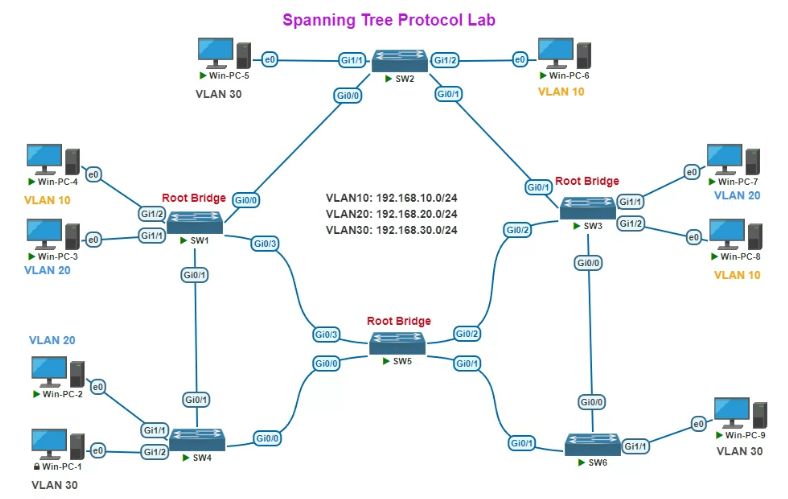
Table of ContentsHow Spanning Tree Protocol Actually WorksComparing STP, RSTP, MSTP, and PVSTConfiguring and Troubleshooting STP: Step by StepSpanning Tree Protocol Command Cheat SheetBringing It All Together Redundant links keep a switched network resilient — but without something managing them, those same redundant paths create loops that can bring a network down in seconds through broadcast storms and duplicate frames. Spanning Tree Protocol (STP) is the mechanism that makes redundancy safe. This guide covers how STP actually operates under the hood, how to choose between its modern variants, the exact commands to configure and troubleshoot it, and a ready-reference cheat sheet for day-to-day work. How Spanning Tree Protocol Actually Works Before touching a single configuration command, it helps to understand the election process and port states that let STP block loops without disconnecting anything permanently. Understand why loops are dangerous in the first place. A physical loop between switches causes broadcast frames to circulate endlessly, consuming bandwidth exponentially and eventually overwhelming switch CPUs and MAC address tables — this is why STP exists at all, even when redundant links are intentional and desirable. Learn how switches exchange BPDUs. Switches running STP send Bridge Protocol Data Units (BPDUs) out every port, containing information used to elect a root bridge and calculate the best path to it. BPDUs are exchanged continuously, not just once at startup, which lets STP react to topology changes. Understand root bridge election. Every switch in the STP domain compares Bridge IDs (a combination of a configurable priority value and the switch's MAC address) advertised in BPDUs, and the switch with the lowest Bridge ID becomes the root bridge — the logical center of the spanning tree that all other switches calculate their best path toward. See how non-root switches pick their best path. Each non-root switch determines its root port — the port with the lowest-cost path back to the root bridge — based on cumulative path cost (influenced by link speed) advertised in received BPDUs. Understand designated ports. On each network segment, the switch offering the lowest-cost path to the root becomes responsible for forwarding traffic on that segment, and its corresponding port becomes the designated port. Any other port on that same segment that isn't a root or designated port becomes a blocking port to prevent a loop. Learn the port states STP cycles through. A port moves through blocking, listening, learning, and finally forwarding states (in traditional 802.1D STP) before it's allowed to pass traffic — this staged progression is what traditionally makes STP convergence slow, since each transition includes a timed delay to avoid temporary loops during topology changes. Recognize how STP reacts to topology changes. If a link fails or a new one comes up, affected switches recalculate the tree — blocked ports may transition to forwarding once they're recalculated as the new best path, restoring connectivity automatically without manual intervention. With the underlying election and port-state mechanism clear, the practical question becomes which STP standard to actually run, since the original 802.1D design has been significantly improved upon since it was first standardized. Comparing STP, RSTP, MSTP, and PVST Multiple IEEE standards and vendor extensions have evolved from the original Spanning Tree Protocol, each addressing different limitations. Here's how they compare: Criteria STP (802.1D) RSTP (802.1w) MSTP (802.1s) PVST+ (Cisco) Convergence time Slow — 30-50 seconds after a topology change Fast — typically 1-2 seconds Fast — same rapid mechanism as RSTP Slow, matching underlying 802.1D timing unless combined with Rapid-PVST+ Spanning tree instances One instance for the entire network One instance for the entire network Multiple instances, each mapped to a group of VLANs One instance per VLAN Load balancing across VLANs Not supported Not supported Supported — different VLAN groups can use different paths Supported — each VLAN can have a different root bridge and active path Standard vs. proprietary IEEE standard (largely legacy) IEEE standard IEEE standard Cisco-proprietary (per-VLAN extension of 802.1D or, as Rapid-PVST+, of 802.1w) Configuration complexity Low Low Higher — requires MST region and instance-to-VLAN mapping Low, but scales with VLAN count since each VLAN runs its own instance Scalability (many VLANs) Poor fit — no per-VLAN awareness Poor fit — no per-VLAN awareness Strong — designed specifically for large VLAN counts Weaker at very large scale — CPU load grows with VLAN count Typical use today Rare in new deployments Common baseline in smaller networks Common in large enterprise campus networks Common in Cisco-only environments, usually as Rapid-PVST+ Best fit Legacy compatibility only Small-to-mid networks, simple topologies Large networks with many VLANs needing efficient link use Cisco shops wanting fast convergence with per-VLAN control without full MSTP complexity In practice, few networks run classic 802.1D STP today. The realistic choice is between Rapid-PVST+ (Cisco's default, giving fast per-VLAN convergence with minimal configuration) and MSTP (better suited once VLAN counts grow large enough that per-VLAN instances become inefficient to manage). Non-Cisco multi-vendor environments typically standardize on RSTP or MSTP directly, since PVST+ is Cisco-specific. Configuring and Troubleshooting STP: Step by Step With a variant chosen, here's the practical sequence for setting root bridge priority, hardening access ports with PortFast and BPDU Guard, and resolving the most common STP problems. Set the STP mode for your chosen variant. switch(config)# spanning-tree mode rapid-pvst Deliberately control root bridge election rather than leaving it to chance. Letting the root bridge be elected purely by lowest MAC address often puts it on the wrong (e.g., access-layer) switch — set priority explicitly on your intended core/distribution switch instead. switch(config)# spanning-tree vlan 10 priority 4096 Configure a secondary root bridge for redundancy. This ensures a predictable failover if your primary root bridge goes down, rather than a random re-election. switch(config)# spanning-tree vlan 10 root secondary Enable PortFast on end-device access ports only. PortFast skips the listening/learning delay for ports that will never connect to another switch, letting end devices get network access immediately instead of waiting 30+ seconds. switch(config-if)# spanning-tree portfast Enable BPDU Guard alongside PortFast. This protects against a device or rogue switch being plugged into a PortFast-enabled port and accidentally (or maliciously) participating in STP — the port is immediately disabled if a BPDU is received where none is expected. switch(config-if)# spanning-tree bpduguard enable Verify STP state and root bridge assignment. switch# show spanning-tree summary switch# show spanning-tree vlan 10 Troubleshoot a topology change flap — check for an unstable link first. Frequent topology change notifications (TCNs) usually point to a flapping physical link or a port going up and down repeatedly, not an STP misconfiguration itself. switch# show spanning-tree detail | include occurr|from Troubleshoot a suspected bridge loop — look for MAC address table instability. A classic symptom of an actual loop (versus a simple flap) is the same MAC address rapidly moving between different ports in the MAC address table, along with abnormally high CPU utilization. switch# show mac address-table | include <suspect-mac> Recover a port disabled by BPDU Guard. If BPDU Guard trips (typically because an unintended device or switch was connected to a PortFast port), the port needs to be manually re-enabled or configured for auto-recovery rather than resolving on its own. switch(config-if)# shutdown switch(config-if)# no shutdown Once root bridge placement is deliberate, PortFast and BPDU Guard are applied consistently across access ports, and TCN/flapping behavior is understood as a symptom to investigate rather than an STP failure itself, most day-to-day STP issues become quick to diagnose rather than mysterious. Spanning Tree Protocol Command Cheat Sheet For quick lookup during deployment or troubleshooting, here's a consolidated reference beyond what was already covered step-by-step above. # --- Mode selection --- # Classic Cisco PVST+ (802.1D per VLAN) switch(config)# spanning-tree mode pvst # Rapid-PVST+ (802.1w per VLAN) - common default switch(config)# spanning-tree mode rapid-pvst # MSTP (802.1s) switch(config)# spanning-tree mode mst # --- Root bridge control --- # Set explicit priority (lower = more likely root) switch(config)# spanning-tree vlan 10 priority 4096 # Auto-calculate priority to become root switch(config)# spanning-tree vlan 10 root primary # Auto-calculate priority as backup root switch(config)# spanning-tree vlan 10 root secondary # --- MSTP region and instance mapping --- switch(config)# spanning-tree mst configuration switch(config-mst)# name REGION1 switch(config-mst)# revision 1 switch(config-mst)# instance 1 vlan 10,20 # --- Port protection --- # Skip listening/learning on edge ports switch(config-if)# spanning-tree portfast # Disable port if unexpected BPDU received switch(config-if)# spanning-tree bpduguard enable # Prevent port from becoming root port switch(config-if)# spanning-tree guard root # Enable both globally on all PortFast ports switch(config)# spanning-tree portfast bpduguard default # --- Cost and timers --- # Manually set path cost on an interface switch(config-if)# spanning-tree cost 10 # Adjust BPDU hello interval (use cautiously) switch(config)# spanning-tree vlan 10 hello-time 2 # --- Verification --- # Overall STP mode and status switch# show spanning-tree summary # Detailed state for a specific VLAN switch# show spanning-tree vlan 10 # STP state for a specific interface switch# show spanning-tree interface gi1/0/1 # View MST region/instance mapping switch# show spanning-tree mst configuration # Verbose detail including TCN counts switch# show spanning-tree detail Keep this reference handy for moments when the concept is already clear and you just need the exact syntax — pair it with the verification commands from the walkthrough above to confirm any change actually took hold as intended. Bringing It All Together Spanning Tree Protocol makes sense once you see it as a continuous negotiation rather than a one-time setup: BPDUs elect a root bridge, port roles get assigned based on path cost, and the resulting tree adapts automatically whenever the topology changes. Choose Rapid-PVST+ or MSTP based on how many VLANs you're managing rather than defaulting to legacy STP, take deliberate control of root bridge placement instead of leaving it to chance, harden access ports with PortFast and BPDU Guard together, and keep the command reference above within reach for troubleshooting. Get those pieces right, and STP becomes one of the most reliable, "set it and forget it" protocols in your network rather than a recurring source of mysterious outages. -
- 224
- SPOTO
- 2026-07-30 14:06
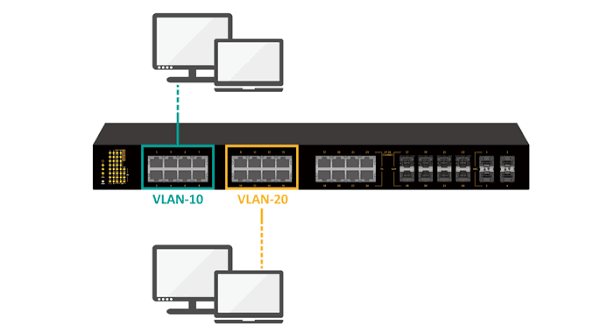
Table of ContentsHow VLAN Technology Works: Tagging, Broadcast Domains, and SegmentationComparing VLAN Types: Static, Dynamic, Voice, and Private VLANsConfiguring and Troubleshooting VLANs: Step by StepVLAN Configuration Command Cheat Sheet Across VendorsBringing It All Together VLANs are how a single physical switch infrastructure gets carved into multiple logical, isolated networks — and they're arguably the single most-used feature in enterprise switching after basic connectivity itself. This guide covers how VLAN tagging actually works under the hood, the different implementation types you can choose between, the exact steps to configure and troubleshoot them, and a ready-to-use command reference across the major switch vendors. How VLAN Technology Works: Tagging, Broadcast Domains, and Segmentation Before choosing a VLAN strategy or typing a single command, it's worth understanding the mechanism that makes VLANs possible in the first place. Start with the problem VLANs solve. Without VLANs, every device connected to a switch (or set of interconnected switches) shares a single broadcast domain — meaning broadcast traffic from any device reaches every other device. As networks grow, this becomes both a performance problem (broadcast traffic multiplies) and a security problem (every device can potentially see every other device's traffic). Understand logical segmentation. A VLAN (Virtual Local Area Network) creates a separate broadcast domain within the same physical switch or set of switches, without requiring separate physical hardware. Devices in different VLANs are isolated from each other at Layer 2 by default, even if they're plugged into the same physical switch. Learn how switches identify which VLAN a frame belongs to. On an access port (a port connecting directly to an end device), the switch simply tags incoming untagged frames with the VLAN configured on that port — the end device itself has no awareness that VLANs exist. Understand 802.1Q tagging for inter-switch links. When traffic for multiple VLANs needs to travel between switches over a single physical link (a trunk), the 802.1Q standard inserts a 4-byte tag into the Ethernet frame header identifying which VLAN the frame belongs to. The receiving switch reads this tag to know which VLAN's broadcast domain the frame should stay within, then strips the tag again before delivering it to an access port. Recognize the native VLAN exception. On a trunk port, one VLAN can be designated as the "native" VLAN — frames belonging to it are sent untagged rather than with an 802.1Q tag. This exists mostly for backward compatibility with older equipment, but it's also a common source of misconfiguration if both ends of a trunk don't agree on which VLAN is native. See how VLANs enable both isolation and controlled communication. Devices within the same VLAN communicate freely at Layer 2. Communication between VLANs requires Layer 3 routing (via a router or a Layer 3 switch with inter-VLAN routing configured), which gives network administrators a deliberate control point for applying security policy between segments. With the underlying tagging mechanism clear, the next question is which VLAN assignment strategy fits your environment — and that's where the different implementation types come in. Comparing VLAN Types: Static, Dynamic, Voice, and Private VLANs Not all VLANs are assigned the same way. Here's how the major implementation types stack up against each other: Criteria Static (Port-Based) VLAN Dynamic VLAN (802.1X-based) Voice VLAN Private VLAN Assignment method Manually configured per switch port Assigned dynamically based on device/user authentication (via RADIUS/802.1X) Configured on a port to carry both a device's voice and data traffic on separate VLANs A VLAN subdivided into isolated sub-groups within the same broadcast domain Configuration effort Low — one command per port Higher — requires RADIUS server integration and 802.1X supplicant configuration Low — a dedicated command alongside the data VLAN on the same port Moderate — requires defining primary and secondary (isolated/community) VLANs Flexibility for mobile users Low — moving to a different port requires reconfiguration High — the correct VLAN follows the authenticated user/device to whatever port they connect on N/A — designed for a fixed voice device (e.g., IP phone) alongside a PC Low — designed for fixed segmentation, not user mobility Typical use case Most general-purpose wired ports in a stable environment BYOD environments, hot-desking, environments needing identity-based network access control Ports serving an IP phone with a daisy-chained PC behind it Hosting/data center environments needing device isolation within a shared subnet Isolation granularity Whole VLAN (broadcast domain) Whole VLAN, but assignment is identity-driven rather than port-driven Separates voice and data traffic onto distinct VLANs on the same physical port Sub-VLAN granularity — devices can be isolated from each other even within the same VLAN Management overhead Low, but scales poorly with frequent device moves Higher upfront (RADIUS setup), lower ongoing (no manual reconfiguration needed) Low Moderate — more moving parts to document and troubleshoot Best fit Stable desks, servers, fixed infrastructure Environments with frequent device/user movement or strict access control needs Any port combining an IP phone and a PC Multi-tenant or shared-subnet environments needing device-to-device isolation Most enterprise networks default to static VLANs for the bulk of fixed infrastructure, layer in voice VLANs wherever IP phones are deployed, and reserve dynamic (802.1X-based) VLANs or private VLANs for the specific use cases — mobility and multi-tenant isolation, respectively — where their added complexity is actually justified. Configuring and Troubleshooting VLANs: Step by Step With a VLAN strategy chosen, here's the practical sequence for setting up access ports, trunk ports, and resolving the most common issues that come up afterward. Commands below use Cisco-style syntax. Create the VLAN(s) on the switch. switch(config)# vlan 10 switch(config-vlan)# name SALES switch(config)# vlan 20 switch(config-vlan)# name VOICE Assign an access port to a VLAN. switch(config)# interface gigabitEthernet 1/0/5 switch(config-if)# switchport mode access switch(config-if)# switchport access vlan 10 Add a voice VLAN to the same port if an IP phone is present. switch(config-if)# switchport voice vlan 20 Configure a trunk port between switches. switch(config)# interface gigabitEthernet 1/0/48 switch(config-if)# switchport trunk encapsulation dot1q switch(config-if)# switchport mode trunk switch(config-if)# switchport trunk allowed vlan 10,20 switch(config-if)# switchport trunk native vlan 99 Verify VLAN and port assignments. switch# show vlan brief switch# show interfaces gigabitEthernet 1/0/5 switchport Troubleshoot a device that can't communicate — check VLAN assignment first. Confirm the port is in the VLAN you expect using the verification command above; a surprising number of "network down" tickets trace back to a port sitting in the wrong (often default) VLAN. Troubleshoot cross-switch connectivity issues — check trunk configuration next. Confirm both ends of the trunk allow the same VLANs and agree on the native VLAN. switch# show interfaces trunk A native VLAN mismatch between the two ends is one of the most common causes of intermittent or one-way connectivity across a trunk link. Troubleshoot inter-VLAN communication issues — check Layer 3 routing. If devices in different VLANs can't reach each other, confirm a Layer 3 device (router or Layer 3 switch) has an interface (or SVI) in each relevant VLAN with correct IP addressing. switch(config)# interface vlan 10 switch(config-if)# ip address 10.10.10.1 255.255.255.0 Confirm end-to-end reachability after making changes. Use basic connectivity testing from an affected device, and re-check the VLAN/trunk verification commands above if the issue persists — most VLAN problems resolve once assignment, trunk configuration, and routing are all confirmed to agree with each other. Once ports are correctly assigned, trunks agree on allowed and native VLANs, and Layer 3 routing exists where needed, VLAN-related issues become rare — most ongoing work at this layer is simply adding new VLANs or ports rather than re-troubleshooting the fundamentals. VLAN Configuration Command Cheat Sheet Across Vendors For quick reference during deployment or troubleshooting, here's a consolidated command set — Cisco IOS commands are shown in full, with HP/HPE (Comware and ProVision) equivalents noted alongside where syntax diverges meaningfully. # --- Create and name a VLAN --- # Cisco: switch(config)# vlan 10 switch(config-vlan)# name SALES # HP Comware: <HP> system-view [HP] vlan 10 [HP-vlan10] name SALES # HP ProVision: switch(config)# vlan 10 switch(vlan-10)# name SALES # --- Assign an access port --- # Cisco: switch(config-if)# switchport mode access switch(config-if)# switchport access vlan 10 # HP Comware: [HP-GigabitEthernet1/0/1] port link-type access [HP-GigabitEthernet1/0/1] port default vlan 10 # HP ProVision: switch(config)# vlan 10 switch(vlan-10)# untagged 1 # --- Configure a trunk port --- # Cisco: switch(config-if)# switchport mode trunk switch(config-if)# switchport trunk allowed vlan 10,20 # HP Comware: [HP-GigabitEthernet1/0/48] port link-type trunk [HP-GigabitEthernet1/0/48] port trunk permit vlan 10 20 # HP ProVision: switch(config)# vlan 10 switch(vlan-10)# tagged 48 # --- Voice VLAN --- # Cisco: switch(config-if)# switchport voice vlan 20 # --- Verification (Cisco) --- switch# show vlan brief switch# show interfaces trunk switch# show interfaces status # --- Verification (HP Comware) --- <HP> display vlan <HP> display interface brief # --- Verification (HP ProVision) --- switch# show vlans switch# show vlans port 1 Keep this section bookmarked as your quick-lookup reference once you already understand the "why" from the configuration walkthrough above — it's built to be copy-pasted, not re-explained each time. Bringing It All Together VLAN technology is straightforward once the pieces click into place: 802.1Q tagging is what lets one physical link carry multiple isolated broadcast domains, the type of VLAN you choose (static, dynamic, voice, or private) depends on whether your priority is simplicity, user mobility, phone deployment, or tenant isolation, and the vast majority of real-world VLAN problems trace back to a port in the wrong VLAN or a trunk disagreement between two switches. Get the tagging concept solid, pick the right VLAN type for each use case rather than defaulting to one everywhere, and keep the command reference above close at hand — that combination covers nearly every VLAN scenario you'll run into. -
- 254
- SPOTO
- 2026-07-30 14:02
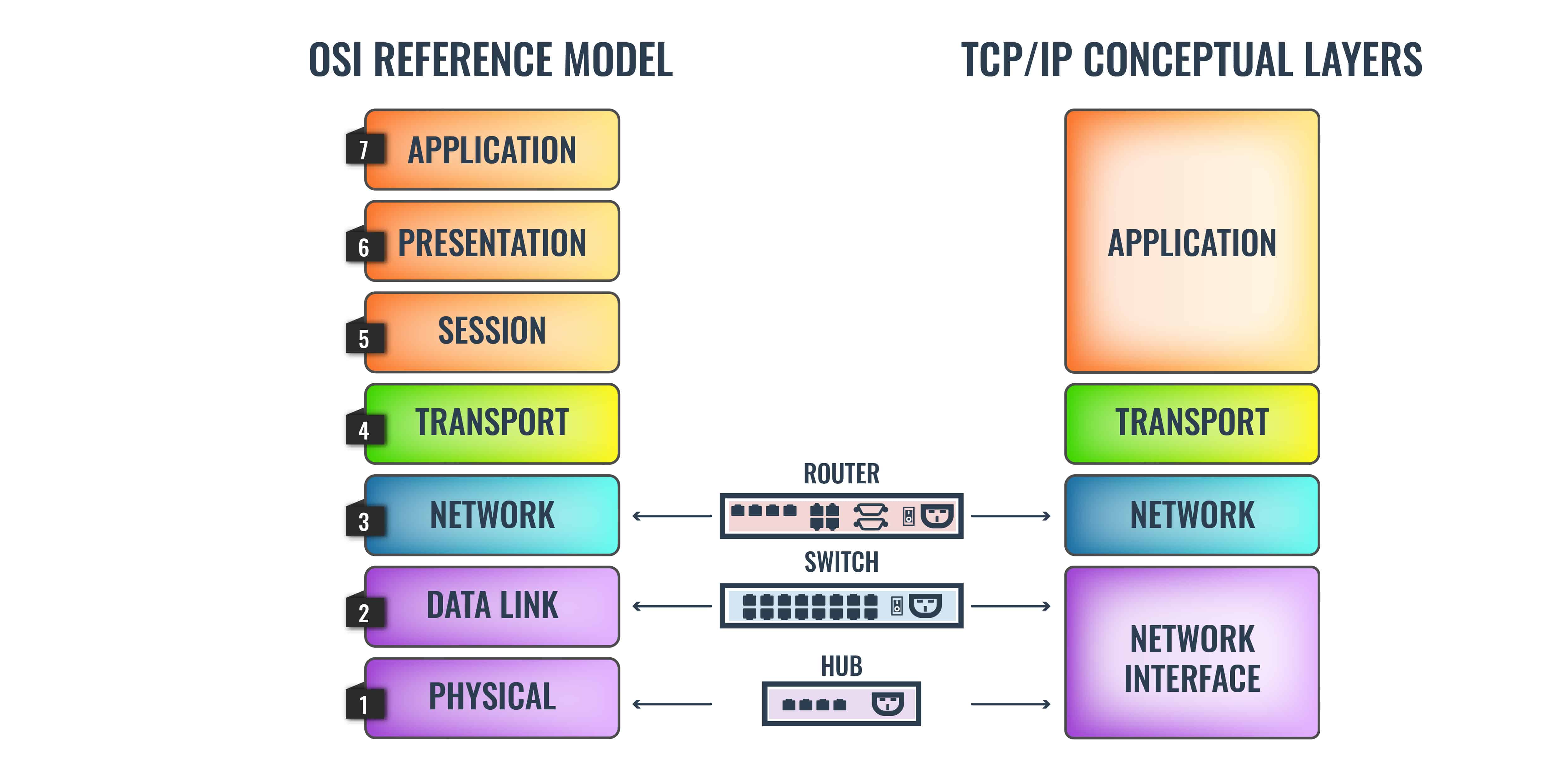
Table of ContentsThe Core Layer 2 Protocols Every Switch Relies OnComparing STP, RSTP, and MSTP for Loop PreventionConfiguring VLAN Trunking and LACP: Step-by-StepLayer 2 Protocol Command Cheat SheetBringing It All Together Every switched network runs on a handful of Layer 2 protocols working quietly in the background — protocols that prevent loops, negotiate trunk links, bundle redundant connections, and let devices discover their neighbors automatically. Understanding what each one does, how the different loop-prevention variants compare, and exactly which commands bring them to life on a real switch is the difference between a network that just works and one that mysteriously breaks the moment you add a second uplink. This guide covers all of it, from concepts through to a ready-reference command sheet. The Core Layer 2 Protocols Every Switch Relies On Before configuring anything, it helps to know what each of these protocols is actually responsible for and how they interact with one another. Spanning Tree Protocol (STP) — loop prevention. Whenever switches are connected with redundant links (for resilience), those links create physical loops that would otherwise cause broadcast storms. STP solves this by electing a root bridge and selectively blocking redundant paths, keeping exactly one active path between any two switches while holding the rest in standby. VLAN Trunking Protocol (VTP) — VLAN database synchronization. In multi-switch environments, VTP lets one switch act as a "server" that propagates VLAN configuration to other switches configured as "clients," so you don't have to manually recreate every VLAN on every switch in the network. Link Aggregation Control Protocol (LACP) — bundling redundant links. Rather than letting STP block a redundant physical link entirely, LACP bundles multiple physical links into a single logical link (an EtherChannel or port channel), giving you both increased bandwidth and redundancy without wasting capacity. Link Layer Discovery Protocol (LLDP) and Cisco Discovery Protocol (CDP) — neighbor discovery. These vendor-neutral (LLDP) and Cisco-proprietary (CDP) protocols let directly connected devices exchange information about themselves — device type, capabilities, port ID — which is invaluable for mapping out a network or troubleshooting physical connectivity without needing existing documentation. How they work together in practice. A typical switch uplink runs LACP to bundle physical links into one logical trunk, that trunk carries 802.1Q-tagged traffic for multiple VLANs (kept in sync across switches via VTP), STP runs underneath to make sure no unintended loop exists outside the bundled link, and LLDP/CDP quietly report neighbor information the whole time for visibility. None of these protocols replace each other — they solve different problems at the same layer. With the roles of each protocol clear, the next natural question is which loop-prevention variant to actually deploy, since STP itself has evolved considerably since its original design. Comparing STP, RSTP, and MSTP for Loop Prevention Spanning Tree Protocol has gone through multiple revisions, and picking the right variant depends heavily on your topology size and convergence requirements. Criteria STP (802.1D) RSTP (802.1w) MSTP (802.1s) Convergence time Slow — up to 30-50 seconds after a topology change Fast — typically under 1-2 seconds Fast — same rapid convergence as RSTP VLAN handling One spanning tree instance for the entire network (or per-VLAN with proprietary extensions) One spanning tree instance for the entire network by default Multiple instances, each mapped to a group of VLANs Best for Legacy networks with minimal redundancy changes; largely superseded today Small to mid-sized networks with a single or few VLANs Larger networks with many VLANs needing load balancing across redundant links Load balancing across links Not supported — one active path for the whole network Not supported — one active path for the whole network Supported — different VLAN groups can use different active paths Configuration complexity Low Low Higher — requires defining MST instances and VLAN-to-instance mapping Backward compatibility N/A (the original standard) Compatible with legacy STP switches (falls back automatically) Compatible with RSTP; requires matching MST region config to interoperate fully with other MSTP switches Typical use case today Rare in new deployments Small offices, simple topologies, or a starting point before MSTP Enterprise campus networks with many VLANs and a need for efficient link utilization The practical guidance: RSTP is the sensible default for most straightforward networks today, since it's simple to configure and converges quickly; reach for MSTP specifically when you have enough VLANs that spreading load across multiple redundant paths meaningfully improves bandwidth utilization, and you're prepared to manage the added instance-mapping complexity that comes with it. Configuring VLAN Trunking and LACP: Step-by-Step With the concepts and STP variant decided, here's how to actually bring 802.1Q trunking and LACP link aggregation to life on a Cisco-style switch. Configure the physical interfaces that will form your bundle. Before enabling LACP, make sure the member ports have matching speed, duplex, and VLAN settings — mismatches here are the most common cause of a bundle failing to form. switch(config)# interface range gigabitEthernet 1/0/1-2 switch(config-if-range)# shutdown Enable LACP on the member interfaces. Use active mode so the switch initiates negotiation rather than waiting passively (use active on at least one side of the connection). switch(config-if-range)# channel-group 1 mode active Verify the port channel interface was created. switch(config-if-range)# no shutdown switch# show etherchannel summary Configure the resulting port-channel interface as an 802.1Q trunk. Once the physical interfaces are bundled, you configure trunking on the logical port-channel interface — not on the individual member ports. switch(config)# interface port-channel 1 switch(config-if)# switchport trunk encapsulation dot1q switch(config-if)# switchport mode trunk Restrict the trunk to only the VLANs it should actually carry. Allowing every VLAN by default is a common security and stability oversight — explicitly list only what's needed. switch(config-if)# switchport trunk allowed vlan 10,20,30 Set a native VLAN for untagged traffic. Make sure both ends of the trunk agree on the native VLAN — a mismatch here is a classic misconfiguration that silently leaks traffic between VLANs. switch(config-if)# switchport trunk native vlan 99 Verify the trunk and LACP bundle are both healthy. switch# show interfaces trunk switch# show etherchannel port-channel switch# show lacp neighbor Confirm STP sees the port-channel as expected. Since the bundle is a single logical interface, STP treats it as one link — check that it's forwarding, not blocking, on the interface you expect. switch# show spanning-tree interface port-channel 1 Once you've verified trunking, LACP bundling, and STP state all agree with each other, the logical link is functioning as intended — bandwidth is aggregated, VLANs are correctly tagged, and the whole bundle appears to STP as a single resilient path rather than multiple separate links it might otherwise block. Layer 2 Protocol Command Cheat Sheet For quick lookup during day-to-day work or troubleshooting, here's a consolidated reference covering the protocols discussed above plus VTP and neighbor discovery, beyond what was already configured step-by-step in the previous section. # --- Spanning Tree Protocol --- switch(config)# spanning-tree mode rapid-pvst # Enable RSTP (per-VLAN) switch(config)# spanning-tree mode mst # Enable MSTP switch(config)# spanning-tree vlan 10 priority 4096 # Influence root bridge election switch# show spanning-tree summary # Verify STP mode and status switch# show spanning-tree vlan 10 # View STP state for a VLAN switch# show spanning-tree mst configuration # View MST region/instance mapping # --- VLAN Trunking Protocol --- switch(config)# vtp mode server # Set switch as VTP server switch(config)# vtp mode client # Set switch as VTP client switch(config)# vtp domain CORP # Set VTP domain name switch(config)# vtp password S3cr3t # Set VTP authentication password switch# show vtp status # Verify VTP mode/domain/revision # --- LACP / EtherChannel --- switch(config-if)# channel-group 1 mode active # Enable LACP (active) switch(config-if)# channel-group 1 mode passive # Enable LACP (passive) switch# show etherchannel summary # View all port-channel bundles switch# show lacp counters # View LACP packet counters # --- LLDP --- switch(config)# lldp run # Enable LLDP globally switch# show lldp neighbors # View discovered neighbors switch# show lldp neighbors detail # Detailed neighbor info # --- CDP (Cisco-only) --- switch(config)# cdp run # Enable CDP globally switch(config-if)# cdp enable # Enable CDP per interface switch# show cdp neighbors # View discovered neighbors switch# show cdp neighbors detail # Detailed neighbor info # --- General troubleshooting --- switch# show interfaces status # Quick port/VLAN/duplex overview switch# show interfaces trunk # Trunk state and allowed VLANs Bookmark this section specifically for moments when you already understand the concept and just need the exact syntax — pair it with the verification commands from the configuration walkthrough above when you need to confirm a change actually took effect. Bringing It All Together Layer 2 protocols are easiest to reason about once you see them as a stack of cooperating layers rather than isolated features: STP (or its faster RSTP/MSTP variants) keeps the topology loop-free, LACP reclaims bandwidth that STP would otherwise block, VLAN trunking and VTP keep segmentation consistent across switches, and LLDP/CDP give you visibility into how it's all physically connected. Start with the right STP variant for your topology size, configure trunking and LACP together rather than as separate afterthoughts, and keep the command cheat sheet handy for the inevitable 2 a.m. troubleshooting session — that combination covers the vast majority of real-world Layer 2 work. -
- 270
- SPOTO
- 2026-07-30 11:08
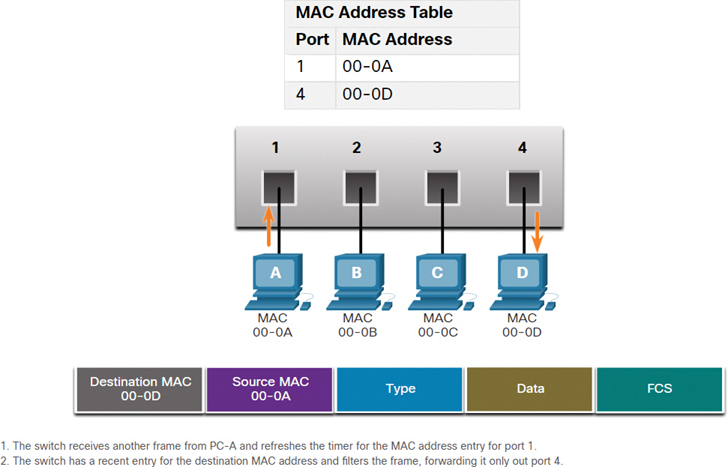
Table of ContentsHow Switches Learn MAC Addresses in the First PlaceStatic vs. Dynamic MAC Entries: Which Should You Use?MAC Address Table CLI Commands: A Quick-Reference Cheat SheetClearing or Flushing the MAC Address Table Without a RebootProtecting the MAC Address Table from Flooding AttacksBringing It All Together Every Ethernet switch relies on a single, deceptively simple data structure to do its job: the MAC address table (also called the CAM table, for Content Addressable Memory). Get comfortable with how it learns addresses, how to view and manipulate it from the CLI, and how to lock it down against attack, and you'll have covered one of the most fundamental — and most exploitable — pieces of switching behavior. This guide walks through the full picture, from the underlying mechanism to the security hardening that protects it. How Switches Learn MAC Addresses in the First Place Before you can manage a MAC address table, it helps to understand exactly how a switch builds one without any manual configuration at all. A frame arrives on a port. When a switch receives an Ethernet frame, it examines the frame's source MAC address — this is the address of the device that sent it, not the destination. The switch records the source address and port. It creates (or refreshes) an entry in the MAC address table mapping that source MAC address to the physical port the frame arrived on. This is the "learning" part of the process, and it happens continuously and automatically for every frame received. The switch checks the destination address against the table. Next, it looks at the frame's destination MAC address and checks whether that address already exists in the table. Known destination → the switch forwards, it doesn't flood. If the destination MAC is already in the table, the switch forwards the frame only out the specific port associated with that address — this is what makes switching more efficient than old-style hub-based flooding. Unknown destination → the switch floods. If the destination MAC isn't yet in the table (common early in a connection, or for a device that rarely transmits), the switch floods the frame out every port in the same VLAN except the one it arrived on. Whichever device actually owns that address responds, and the switch learns its location from that reply. Entries age out over time. Dynamically learned entries aren't permanent — each has an aging timer (300 seconds/5 minutes is the common default) that resets every time a frame is seen from that source address. If no traffic arrives from a MAC address before its timer expires, the entry is removed to keep the table from filling with stale data. The table adapts automatically to topology changes. If a device moves to a different port (or its NIC changes), the switch simply relearns the new source-port mapping the next time that device transmits — no manual intervention needed under normal operation. This self-learning behavior is what makes switches "plug and play" for basic connectivity — but it's also exactly the mechanism attackers try to exploit, which is why the security section later in this guide matters just as much as the mechanics above. Static vs. Dynamic MAC Entries: Which Should You Use? Once you understand how dynamic learning works, the next practical question is whether you should ever override it with manually configured static entries. Here's how the two approaches compare: Criteria Dynamic Entries Static Entries Configuration effort None — learned automatically Manual entry per device, per port Scalability Scales effortlessly to thousands of devices Impractical beyond a small number of critical devices Adapts to device moves Yes — relearns automatically No — must be manually updated if device moves Table stability Entries age out and get relearned continuously Entries never age out or get removed automatically Security posture Vulnerable to MAC flooding without additional protections Immune to flooding-based table exhaustion for those specific entries Best use case General end-user ports, guest devices, most of the network Critical infrastructure: servers, network management stations, security cameras with fixed ports Management overhead Low Grows linearly with number of static entries Risk if misconfigured Low — self-correcting Can cause connectivity issues if a device's actual MAC or port changes and the static entry isn't updated In practice, most networks run almost entirely on dynamic learning and reserve static entries for a small handful of high-value, rarely-moved devices — pairing static entries for critical infrastructure with the port security features covered later gives you the stability benefits without the full management burden of static entries everywhere. MAC Address Table CLI Commands: A Quick-Reference Cheat Sheet With the concepts and trade-offs covered, here are the exact commands you'll reach for most often when working with a MAC address table (Cisco IOS syntax shown; most other vendors follow a very similar pattern). # View the entire MAC address table switch# show mac address-table # View MAC entries learned on a specific interface switch# show mac address-table interface gigabitEthernet 1/0/1 # View MAC entries for a specific VLAN switch# show mac address-table vlan 10 # View only dynamically learned entries switch# show mac address-table dynamic # View only statically configured entries switch# show mac address-table static # Count total MAC addresses in the table switch# show mac address-table count # Configure a static MAC address entry (bind MAC to a port/VLAN) switch(config)# mac address-table static 0011.2233.4455 vlan 10 interface gigabitEthernet 1/0/5 # Remove a specific static MAC entry switch(config)# no mac address-table static 0011.2233.4455 vlan 10 interface gigabitEthernet 1/0/5 # Change the aging time for dynamic entries (in seconds) switch(config)# mac address-table aging-time 600 # Disable aging entirely for a VLAN (use with caution) switch(config)# mac address-table aging-time 0 vlan 10 Keep this list handy for day-to-day troubleshooting — but note that clearing entries (covered next) uses a different command family entirely from viewing or configuring them. Clearing or Flushing the MAC Address Table Without a Reboot Sometimes you need to force the table to relearn from scratch — after a topology change, a suspected stale entry, or during troubleshooting — without rebooting the switch. Here's how to do it across the most common platforms. Identify why you need to clear the table. Common triggers include a device that moved ports but the switch hasn't relearned yet (before the aging timer naturally expires), suspected MAC spoofing, or verifying that a fix actually resolved a Layer 2 loop or duplicate-MAC issue. On Cisco switches, clear the entire dynamic table. switch# clear mac address-table dynamic On Cisco switches, clear entries for a specific interface only. switch# clear mac address-table dynamic interface gigabitEthernet 1/0/1 On Cisco switches, clear entries for a specific VLAN only. switch# clear mac address-table dynamic vlan 10 On HP/HPE (Comware or ProVision) switches, use the equivalent flush command. switch# clear mac-address (Comware-based switches use reset mac-address-table dynamic instead — check your specific platform family, since HP's syntax varies between ProVision and Comware OS.) On Huawei switches, use the reset command. <Huawei> reset mac-address dynamic Verify the clear operation worked. Immediately after clearing, run the show/display mac-address equivalent for your platform — the table should show a sharp drop in entries, which then repopulate naturally as traffic resumes. Expect a brief flooding period after clearing. Right after a flush, the switch has no dynamic entries, so it will flood unicast frames to unknown destinations until it relearns — this is normal and typically resolves within seconds on an active network. Clearing the table is a safe, non-disruptive operation on its own — the brief flooding period is a normal side effect, not a sign something went wrong. Protecting the MAC Address Table from Flooding Attacks The dynamic learning behavior covered earlier has an exploitable weakness: an attacker can flood a switch with frames using thousands of fake source MAC addresses, filling the table's finite capacity. Once full, many switches fail open — flooding all traffic to all ports like a hub, which lets an attacker on any port sniff traffic meant for other devices. Port security is the primary defense. Enable port security on access ports. This is the foundational step — port security restricts how many and which MAC addresses are allowed to be learned on a given port. switch(config)# interface gigabitEthernet 1/0/1 switch(config-if)# switchport mode access switch(config-if)# switchport port-security Set a maximum number of allowed MAC addresses per port. For a typical end-user port with a single device, one is usually sufficient; adjust upward for ports feeding an IP phone plus a PC. switch(config-if)# switchport port-security maximum 2 Choose a violation action. This determines what happens when the maximum is exceeded — protect (drop offending traffic silently), restrict (drop and log/increment a counter), or shutdown (err-disable the port entirely, the most secure but most disruptive default). switch(config-if)# switchport port-security violation restrict Decide between sticky and fully static learning. "Sticky" learning lets the switch dynamically learn the first allowed MAC address(es) and then convert them to static entries automatically — a good middle ground between manual effort and security. switch(config-if)# switchport port-security mac-address sticky Set an aging time for port-security entries if needed. This allows legitimate device changes (like a laptop swap) to be accommodated without manual intervention, while still capping the number of simultaneous addresses. switch(config-if)# switchport port-security aging time 60 switch(config-if)# switchport port-security aging type inactivity Verify port security status and violation counts. switch# show port-security interface gigabitEthernet 1/0/1 switch# show port-security address Recover an err-disabled port after a violation. If you used the shutdown violation action and a port trips, it needs to be manually re-enabled (or configured for auto-recovery) rather than clearing on its own. switch(config)# interface gigabitEthernet 1/0/1 switch(config-if)# shutdown switch(config-if)# no shutdown Layer in additional protections for high-risk environments. Beyond port security, features like DHCP snooping and Dynamic ARP Inspection complement MAC-table protection by addressing related spoofing vectors that port security alone doesn't cover. Port security turns the switch's biggest structural weakness — unlimited automatic learning — into a bounded, monitored process, which is the difference between a MAC flooding attempt failing quietly and one that takes down visibility across an entire VLAN. Bringing It All Together The MAC address table is one of those pieces of networking infrastructure that works invisibly until something goes wrong — a device that won't reconnect after a move, a suspicious flood of unknown traffic, or a switch behaving like a hub during an attack. Understanding the learning mechanism covered at the start of this guide makes the rest fall into place naturally: you'll know when static entries are worth the management overhead, which commands to reach for during day-to-day work or troubleshooting, and why port security isn't optional hardening but a direct countermeasure to how the table itself is built. Master these fundamentals, and MAC-table issues go from mysterious to routine. -
Building a Switched Campus Network That Scales: Design, Vendors, Configuration, and Refresh Planning
- 201
- SPOTO
- 2026-07-30 10:57
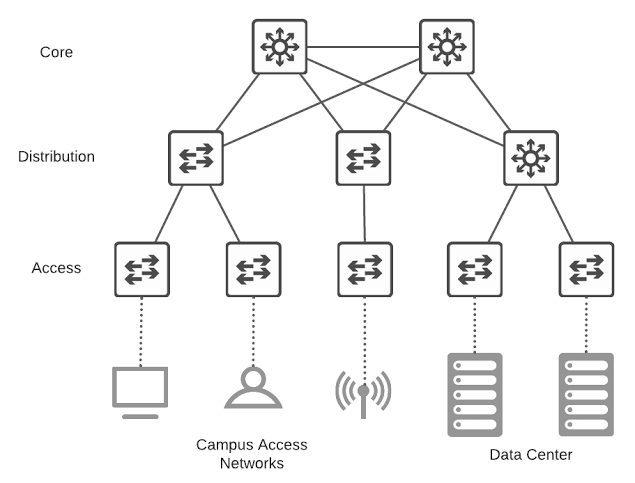
Table of ContentsChoosing Your Campus Architecture: Three-Tier vs. Collapsed CoreComparing Campus Switch Vendors: Cisco, Aruba, and FortinetConfiguring VLAN Segmentation and Inter-VLAN RoutingPlanning a Campus Switch Refresh and PoE Power BudgetBringing It All Together A switched campus network is the backbone that connects every user, device, and access point across a building or corporate site — and getting the design wrong early on tends to create scaling headaches years later. This guide walks through the full lifecycle: choosing the right architectural model, picking hardware from the vendors that actually compete in this space today, configuring the VLAN and routing layer that makes segmentation work, and finally, planning the hardware refresh and power budget that keeps the network sustainable long-term. Choosing Your Campus Architecture: Three-Tier vs. Collapsed Core The first decision in any campus network design is how many layers of switching sit between your end devices and your routed core. There are two dominant models, and the right one depends almost entirely on campus size. Start with the access layer, regardless of architecture. Every campus design begins with access switches — the ones physically connecting end devices, phones, and access points. This layer handles port security, VLAN assignment, and Power over Ethernet (PoE) delivery, and its design doesn't change much between the two models below. Decide whether you need a distribution layer. In a traditional three-tier architecture, a distribution layer sits between access and core, aggregating multiple access switches, handling inter-VLAN routing, and enforcing policy before traffic reaches the core. This layer earns its keep in large campuses — typically multiple buildings or floors with dozens of access switches — because it localizes routing decisions and contains failure domains. Consider collapsing distribution and core for smaller sites. A collapsed core architecture merges the distribution and core layers into a single tier, with access switches connecting directly to a pair of high-capacity core switches that also perform routing. This reduces hardware cost, cabling complexity, and hop count — ideal for a single building or a small-to-medium campus where a full three-tier design would be over-engineered. Build redundancy into whichever model you choose. Both architectures should use dual uplinks from every access switch to two distribution or core switches, with a first-hop redundancy protocol (such as HSRP or VRRP) protecting the default gateway. Redundancy isn't a "nice to have" tier — it's what keeps a single switch or link failure from taking down a whole floor. Size your core for growth, not current load. Whether you go three-tier or collapsed core, the core (or collapsed core/distribution) layer should be sized with headroom for at least the next hardware refresh cycle — typically 3–5 years — since core upgrades are far more disruptive than access-layer swaps. Match uplink bandwidth to access-layer density. As you add more high-density access switches (especially ones powering Wi-Fi 6E/7 access points), make sure uplink bandwidth between tiers scales accordingly — a common oversight is upgrading access switches without upgrading the uplinks feeding them, which just moves the bottleneck up one layer. The practical rule of thumb: if you're managing a single building or a handful of wiring closets, a collapsed core keeps things simple and cost-effective; once you're coordinating multiple buildings or need to isolate routing domains for scale, the three-tier model earns its added complexity. Comparing Campus Switch Vendors: Cisco, Aruba, and Fortinet Once your architecture is settled, the next decision is hardware. The competitive landscape shifted meaningfully in 2025, so it's worth comparing where each vendor actually stands today rather than relying on older comparisons. Criteria Cisco (Catalyst) HPE Aruba Networking Fortinet (FortiSwitch) Core strength Robust architecture and global reputation, with a large base of trained professionals and consistent performance across industries One of the strongest Cisco alternatives specifically for campus switching and wireless Strongest fit when the network design is security-led rather than pure switching performance Portfolio breadth (post-2025) Broadest standalone campus/data center/wireless lineup Following HPE's 2025 acquisition of Juniper Networks, the combined HPE Networking portfolio broadened across campus, wireless, routing, data center, and AI-driven operations Positions itself as the only vendor offering fully converged wired and wireless networking with AI-powered security through a single platform Typical use case Data centers, campuses, and WAN connectivity, with strong access-layer, core, and edge networking integration Large campus and wireless-heavy deployments wanting a single vendor across switching, Wi-Fi, and (now) routing SD-Branch and campus deployments where security integration with a firewall platform is a priority Security integration Strong via Cisco's broader security portfolio, sold as a complementary layer Strong via Aruba ClearPass and, increasingly, integration across the expanded HPE/Juniper stack Deep native integration with FortiGate for unified management and policy enforcement Management model CLI plus cloud/on-prem management tools depending on product line Centralized cloud-native management (Aruba Central) across switching and wireless Single-pane-of-glass administration regardless of how users or devices connect Price positioning Generally positioned at a premium compared to other vendors Mid-to-premium, varies significantly by acquired product line Positioned as a cost-effective option, especially when bundled with existing FortiGate infrastructure Best fit Large enterprises standardizing on a broad, mature ecosystem Organizations prioritizing unified campus + wireless with growing routing ambitions Organizations where security policy, not just switching throughput, drives network design No single vendor wins on every axis — the right choice depends on whether your priority is ecosystem maturity (Cisco), a newly broadened campus-to-routing portfolio (HPE Aruba), or tight security-switching convergence (Fortinet). Many organizations shortlist based on what they already run for firewalls or wireless, since switch management increasingly ties into that existing platform. Configuring VLAN Segmentation and Inter-VLAN Routing With architecture and hardware chosen, the practical work begins: segmenting traffic with VLANs and enabling routing between them. The steps below use standard Cisco-style CLI syntax, but the same logical sequence applies across most enterprise switch platforms with adjusted command syntax. Create your VLANs on the switch. switch(config)# vlan 10 switch(config-vlan)# name DATA switch(config)# vlan 20 switch(config-vlan)# name VOICE switch(config)# vlan 99 switch(config-vlan)# name MANAGEMENT Assign access ports to their VLAN. switch(config)# interface range gigabitEthernet 1/0/1-24 switch(config-if-range)# switchport mode access switch(config-if-range)# switchport access vlan 10 switch(config-if-range)# switchport voice vlan 20 Configure trunk ports between access and distribution/core switches. switch(config)# interface gigabitEthernet 1/0/48 switch(config-if)# switchport mode trunk switch(config-if)# switchport trunk allowed vlan 10,20,99 switch(config-if)# switchport trunk native vlan 99 Enable inter-VLAN routing with Switch Virtual Interfaces (SVIs) on your distribution or collapsed-core switch. switch(config)# ip routing switch(config)# interface vlan 10 switch(config-if)# ip address 10.10.10.1 255.255.255.0 switch(config)# interface vlan 20 switch(config-if)# ip address 10.10.20.1 255.255.255.0 Add first-hop redundancy if you have dual distribution/core switches. switch(config)# interface vlan 10 switch(config-if)# standby 10 ip 10.10.10.1 switch(config-if)# standby 10 priority 110 switch(config-if)# standby 10 preempt Verify VLAN and trunk state before troubleshooting further. switch# show vlan brief switch# show interfaces trunk switch# show standby brief Troubleshoot latency or connectivity issues systematically. Check for VLAN mismatches on trunk ports first (the most common cause of "phantom" connectivity issues), then confirm spanning-tree isn't blocking an expected path, and finally check for duplex/speed mismatches on uplinks — all three account for the large majority of real-world campus VLAN problems. Once VLANs, trunks, and routing are verified end-to-end, the segmentation itself becomes largely "set and forget" — most ongoing work at this layer is adding new VLANs as departments or device types are onboarded, not re-architecting what's already running. Planning a Campus Switch Refresh and PoE Power Budget The final piece of the lifecycle is knowing when and how to refresh access-layer hardware — particularly as PoE demands grow with more access points, phones, and IoT devices. Use the templates below as working documents for your own refresh project. CAMPUS SWITCH REFRESH CHECKLIST ================================ [ ] Phase 1: Current-state audit - Inventory all switch models, firmware versions, and end-of-support/end-of-life dates - Document current port utilization per switch (% of ports actively used) - Record current PoE draw per switch vs. rated PoE budget [ ] Phase 2: Future requirements - List planned device additions (APs, phones, cameras, IoT sensors) for the next 3-5 years - Confirm PoE class needed per device type (802.3af / 802.3at / 802.3bt) - Note any multi-gig (2.5G/5G) uplink requirements for Wi-Fi 6E/7 access points [ ] Phase 3: Vendor and model shortlist - Shortlist 2-3 vendors based on comparison criteria above - Request quotes with matching port count, PoE budget, and uplink speed - Confirm licensing model (perpetual vs. subscription) for management/cloud features [ ] Phase 4: Migration planning - Define cutover order (least critical closets first) - Plan maintenance windows per switch/closet - Pre-stage configs before physical swap - Confirm rollback plan per closet [ ] Phase 5: Post-refresh validation - Verify VLAN, trunk, and routing config matches pre-refresh - Confirm PoE draw is within new budget with headroom - Update documentation and asset inventory POE POWER BUDGET CALCULATION TEMPLATE ======================================= Per-device PoE draw (typical, plan for worst case): 802.3af (PoE) : up to 15.4W delivered, ~12.95W at device 802.3at (PoE+) : up to 30W delivered, ~25.5W at device 802.3bt (PoE++) : up to 60-90W delivered, ~51-71W at device Budget formula per switch: Required PoE budget = (Number of devices per class) x (Per-device draw for that class) x (Safety margin, typically 1.2x) Example worksheet: Device type | Count | Class | Draw/device | Subtotal ----------------------|-------|----------|-------------|---------- VoIP phones | __ | 802.3af | 12.95W | ____ Wi-Fi 6E APs | __ | 802.3at | 25.5W | ____ Wi-Fi 7 APs | __ | 802.3bt | 51-71W | ____ IP cameras (PTZ) | __ | 802.3bt | 51-71W | ____ IoT sensors (misc) | __ | 802.3af | 12.95W | ____ ---------------------------------------------------------------- Subtotal (sum above) : ____ x Safety margin (1.2) : ____ = Required switch PoE budget : ____ Compare against candidate switch's rated PoE budget. If required budget exceeds ~80% of rated budget, shortlist a higher-PoE-budget model or add a switch. Running the audit and calculation above before requesting vendor quotes ensures you're comparing switches on the metric that actually matters for your environment — total usable PoE budget with headroom — rather than just port count or list price. Bringing It All Together A switched campus network holds together when each layer is deliberately chosen rather than inherited from whatever was installed last: pick collapsed core or three-tier based on your actual campus size, choose a vendor whose strengths align with what's driving your network — ecosystem maturity, unified wireless-and-routing, or security convergence — configure VLANs and routing with redundancy built in from day one, and refresh hardware based on a real PoE and capacity audit rather than a fixed replacement cycle. Get those four decisions right, and the network becomes something you're managing proactively instead of firefighting. -
- 604
- SPOTO 2
- 2026-07-30 10:22
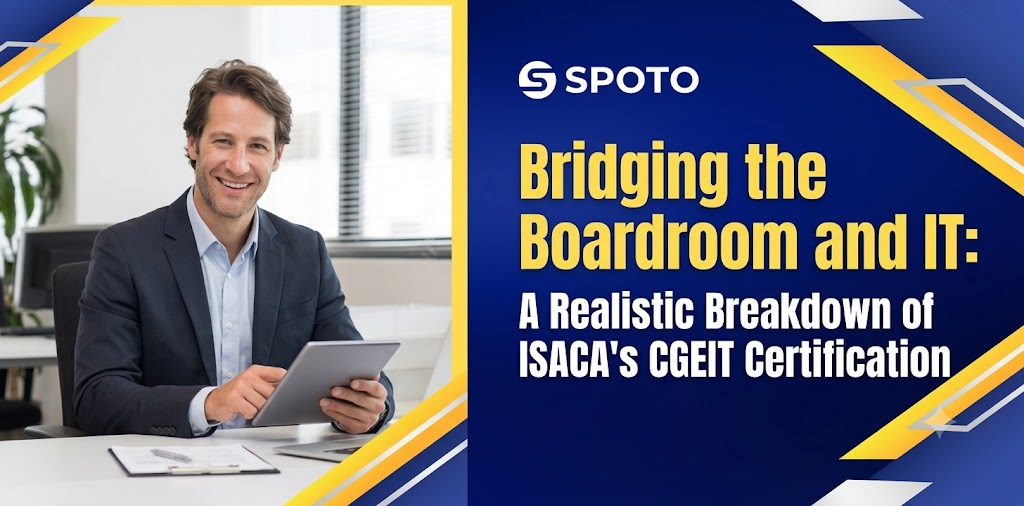
Table of Contents1. Why CGEIT Matters in Executive Circles2. Exam Breakdown and Core Domains3. Requirements and Test Preparation4. Salary Expectations and Career Growth5. Pairing CGEIT with Other Certifications When multi-million-dollar digital transformations go off the rails, it is almost never because an engineer typed the wrong command. Projects fail because executive leadership lost track of ROI, misjudged risk tolerance, or failed to align IT spending with actual corporate goals. This disconnect is why organizations value the Certified in the Governance of Enterprise IT (CGEIT) credential. Offered by ISACA, CGEIT isn't about running command lines or managing daily helpdesk queues. It tests whether you can build governance frameworks, manage resource lifecycles, and explain the business value of technology investments to executive boards and stakeholders. Here is a practical look at what the CGEIT covers, its core domains, realistic salary expectations, and what it takes to pass. 1. Why CGEIT Matters in Executive Circles Most IT credentials measure your ability to build, fix, or secure systems. CGEIT evaluates whether those systems actually serve the business. It shifts your perspective from operational maintenance to strategic alignment and value delivery. A few reasons senior leaders respect the certification: Executive Recognition: Accredited under ANSI standards, CGEIT is recognized by global audit firms, regulatory bodies, and enterprise boards in over 180 countries. Geared Toward Leadership: The material is tailored for decision-makers—such as IT Directors, Governance Leads, Enterprise Architects, Chief Risk Officers (CROs), and prospective CIOs. Focus on Business Value: Rather than teaching proprietary software, CGEIT relies on governance principles like COBIT and ISO/IEC 38500 to help you track ROI, evaluate risk, and establish clear operational accountability. 2. Exam Breakdown and Core Domains The CGEIT exam gives you 4 hours (240 minutes) to complete 150 multiple-choice questions. Scores are reported on a scaled range from 200 to 800, with 450 points required to pass. ISACA structures the current CGEIT exam around four main domains: Domain 1: Governance of Enterprise IT (40%): The largest section by far. It focuses on establishing and maintaining governance frameworks, organizational structures, strategy alignment, enterprise architecture, and regulatory compliance. Domain 2: IT Resources (15%): Covers managing IT assets, human capital, and vendor relationships. You are tested on capacity planning, sourcing strategies, SLAs, and resource lifecycles. Domain 3: Benefits Realization (26%): Evaluates whether IT investments deliver their promised financial and operational returns. Key topics include business case creation, KPI tracking, ROI metrics, and continuous process improvement. Domain 4: Risk Optimization (19%): Focuses on aligning IT risk with overall Enterprise Risk Management (ERM). It covers setting risk appetite, tracking Key Risk Indicators (KRIs), business continuity planning, and threat mitigation. 3. Requirements and Test Preparation Because CGEIT is an executive-level certification, ISACA enforces strict experience requirements: 5 Years of Governance Experience: You must document at least 5 years of experience managing or advising enterprise IT governance within the 10 years prior to your application. Crucially, at least 1 full year must involve establishing or managing an enterprise IT governance framework directly. Think Like an Advisor: The biggest mistake technical candidates make on the exam is choosing immediate hands-on fixes. CGEIT questions expect you to think like a board advisor. When an issue comes up, the correct response usually involves assessing business impact, consulting risk owners, or updating policy—not troubleshooting code yourself. Scenario-Based Study: Questions focus on situational judgment under tight time constraints. Preparing with realistic practice question sets—like the CGEIT review modules from SPOTO—helps you adapt to ISACA's exam logic, identify domain weak points, and manage your time effectively during the 4-hour test. Certification Maintenance: Once certified, you maintain your status by adhering to ISACA's Code of Ethics, paying an annual maintenance fee, and logging at least 20 CPE credits per year (120 credits over a 3-year cycle). 4. Salary Expectations and Career Growth Since CGEIT holders typically operate in senior management or advisory roles, compensation reflects their strategic level of responsibility. While location and organization size create variances, typical pay ranges include: Senior GRC Manager / Risk Lead: Professionals overseeing governance structures, regulatory compliance, and internal controls earn between $120,000 and $145,000. IT Director / Security Governance Manager: Leaders managing IT alignment, vendor contracts, and enterprise strategy earn between $140,000 and $165,000. Chief Risk Officer (CRO) / Enterprise Architect Lead: Executives directing corporate risk practices or heading enterprise IT strategy command total packages ranging from $170,000 to $210,000+. 5. Pairing CGEIT with Other Certifications If you are planning your long-term career roadmap, CGEIT complements several specialized credentials: CGEIT + CISA: Combines hands-on IT auditing skills with high-level corporate governance. CGEIT + CRISC: Bridges operational risk quantification with board-level risk optimization frameworks. CGEIT + CISM: Pairs information security program management with overall IT strategy and investment oversight. -
- 551
- SPOTO 2
- 2026-07-30 10:07
Table of Contents1. Why Technical Privacy Expertise Commands High Market Value2. Recent Syllabus Refresh: The Move to Four Core Domains3. Exam Format, Criteria, and Preparation Strategy4. Realistic Pay and Career Trajectory5. How CDPSE Pairs with Other Certifications For years, corporate data privacy was treated mostly as a legal task. Companies wrote long privacy policies, updated terms of service, and relied on compliance lawyers to make sure they stayed on the right side of regulations like GDPR or CCPA. That approach fell apart once modern cloud architectures, complex API pipelines, and AI models took over. Today, writing a policy isn't enough—you have to write code that actually enforces it. Organizations need technical professionals who can translate legal requirements into working system architectures, data flow diagrams, and encryption standards. That gap between legal policy and technical implementation is exactly where ISACA's Certified Data Privacy Solutions Engineer (CDPSE) fits. It is designed specifically for engineers, software architects, and GRC leads who build privacy directly into software, databases, and IT operations. Here is a ground-level breakdown of the CDPSE credential, including its recent syllabus updates, domain weightings, exam structure, real-world salary expectations, and practical study advice. 1. Why Technical Privacy Expertise Commands High Market Value Most traditional privacy certifications focus heavily on statutory law and regulatory theory. While knowing legal definitions is useful, IT leadership and engineering managers face a different set of challenges. Holding the CDPSE proves you understand how to answer these practical engineering questions. It demonstrates that you can bridge the gap between compliance teams and technical developers, ensuring privacy controls are embedded into the software development lifecycle rather than slapped on after a breach. 2. Recent Syllabus Refresh: The Move to Four Core Domains To keep pace with complex cloud environments, cross-border data transfers, and automated data processing, ISACA updated the CDPSE Job Practice outline. The update expanded the exam from its original three-domain structure into four specialized domains, placing significantly heavier weight on hands-on privacy engineering and risk management: Domain 1: Privacy Governance (20% of exam): Focuses on organizational privacy frameworks, policy integration, privacy documentation, vendor risk management, and setting up accountability roles across engineering teams. Domain 2: Privacy Risk Management and Compliance (18% of exam): Covers conducting Privacy Impact Assessments (PIAs), identifying vulnerabilities, evaluating threat vectors, and building monitoring metrics to demonstrate regulatory compliance. Domain 3: Data Life Cycle Management (23% of exam): Centers on protecting personal data across its entire lifespan—from collection and purpose limitation to data inventory mapping, cross-border transfers, retention, archiving, and secure destruction. Domain 4: Privacy Engineering (39% of exam): The single largest and most technical portion of the exam. Evaluates your ability to build privacy controls into IT infrastructure, secure APIs, implement identity and access management (IAM), handle anonymization and pseudonymization, apply Privacy-Enhancing Technologies (PETs), and manage privacy risks in AI/ML pipelines. 3. Exam Format, Criteria, and Preparation Strategy Earning the official CDPSE designation requires clearing both the examination and ISACA's professional background checks: (1) Exam Structure The test consists of 120 multiple-choice questions delivered over a 3.5-hour (210-minute) window. Final scores are converted to a scaled range between 200 and 800 points, with 450 required to pass. (2) Experience Requirement Candidates must document at least 3 years of cumulative, paid work experience across technical privacy governance, privacy architecture, or data lifecycle management within the 10 years prior to application. Unlike some introductory credentials, ISACA requires authentic field experience to hold the full certification. (3) Practical Preparation Because the CDPSE relies heavily on scenario judgment rather than simple definition memorization, passing requires understanding how privacy principles work under real engineering constraints. On the exam, questions frequently present a technical trade-off and ask for the most effective implementation method. Working through updated scenario question sets—such as the study modules and practice sets from SPOTO—helps candidates get comfortable with ISACA's scenario logic, master time management across 120 questions, and identify specific domain gaps before test day. (4) Credential Maintenance To keep the certification active, CDPSE holders must adhere to ISACA's Code of Professional Ethics, pay an annual maintenance fee, and log at least 20 Continuing Professional Education (CPE) credits each year (totaling at least 120 CPEs over a three-year cycle). 4. Realistic Pay and Career Trajectory Because professionals who understand both software engineering and privacy regulations are relatively rare, market demand across CDPSE-aligned roles remains strong. While compensation varies by location, experience, and industry, general pay ranges include: Data Privacy Analyst / GRC Specialist: Early-to-mid career professionals handling privacy impact assessments, third-party vendor tracking, and compliance audits typically earn base salaries between $95,000 and $120,000. Privacy Engineer / Data Architect: Technical specialists designing privacy-enhancing controls, consent management platforms, and cloud data pipelines earn between $125,000 and $160,000. Director of Privacy Engineering / Chief Privacy Officer (CPO): Senior leaders overseeing corporate data privacy architecture, regulatory reporting, and enterprise-wide risk management command total packages ranging from $165,000 to $210,000+. 5. How CDPSE Pairs with Other Certifications If you are mapping out your long-term career in IT risk and compliance, combining CDPSE with other credentials creates a well-rounded skill set: CDPSE + CISA: Combines technical privacy implementation skills with formal IT auditing and control verification. CDPSE + CRISC: Connects data privacy engineering with broader enterprise risk management and risk quantification. CDPSE + CISM: Bridges hands-on privacy architecture with high-level information security program management. -
- 269
- SPOTO
- 2026-07-29 15:47
Table of ContentsIs the Get Certified Get Ahead SY0-701 Guide Worth Buying?A Realistic SY0-701 Study Schedule Using This GuideSY0-601 vs. SY0-701: What Actually ChangedBringing It Together CompTIA Security+ SY0-701 is currently the only active version of the exam, and one book keeps coming up in nearly every prep discussion: Darril Gibson's Get Certified Get Ahead. But picking a study guide is only the first decision — you also need a realistic schedule, a clear picture of how SY0-701 differs from the retired SY0-601 so your materials aren't outdated, and a way to actually test your readiness before exam day. Here's how all four pieces fit together. Is the Get Certified Get Ahead SY0-701 Guide Worth Buying? Before committing study hours to any book, it helps to know exactly what you're getting. Here's what stands out about this particular guide: Proven track record. The book has a loyal following because it's straightforward, practical, and relentlessly focused on helping readers pass on their first try, and the series has helped thousands of readers pass the exam on their first attempt across multiple exam versions. Updated authorship team. The current SY0-701 edition is co-authored by Darril Gibson and Joe Shelley — Shelley is a Chief Information Officer working in higher education who oversees information security and privacy programs, IT risk management, and data governance, bringing a practitioner's perspective alongside Gibson's long-running certification-writing background. Digestible structure. Material is organized into 11 chapters, each ending with an "Exam Topic Review" that reinforces the most critical points, which makes it easier to study in short, focused sessions rather than marathon reading blocks. Teaching style people actually credit for results. Gibson's real-world examples and classroom-tested analogies make security principles easy to understand, even for readers with limited IT backgrounds. Heavy practice-question volume. The guide includes a 50-question pre-test, practice questions at the end of every chapter, and a full 90-question practice exam, with every question accompanied by a detailed explanation of why each answer is right or wrong. Free supplementary resources. Buyers get access to free online resources, including additional practice test questions through an online testing platform, extending your practice pool beyond what's printed in the book. Fully current for the active exam version. This edition covers the SY0-701 exam objectives, which remain current through 2027, so you're not risking outdated content the way you would with leftover SY0-601 materials. The consistent theme across reviews is that this guide earns its reputation less from flashy production value and more from clear explanations and a genuinely large volume of practice material — which matters more than most other factors when you're trying to pass on the first attempt. A Realistic SY0-701 Study Schedule Using This Guide Once you've got the book, the next question is how to actually pace yourself. Here's a structured approach built around the guide's 11-chapter format and heaviest-weighted domains (more on those weights in the next section): Week 1 — Diagnostic baseline. Take the 50-question pre-test cold, before reading anything. Don't worry about your score — use it purely to identify which of the five domains you're already comfortable with and which need the most attention. Weeks 2–3 — Front-load the heavy domains. Start with the chapters covering Security Operations and Threats, Vulnerabilities, and Mitigations first, since these two domains alone make up roughly half the exam. Read the chapter, then immediately do the end-of-chapter practice questions — don't batch reading across multiple chapters before testing yourself. Week 4 — Architecture and governance chapters. Move into Security Architecture and Security Program Management and Oversight. These domains lean more conceptual, so pair your reading with real-world scenarios (cloud configurations, compliance frameworks you've encountered at work) to make the material stick. Week 5 — General Security Concepts and cleanup. This domain carries the lowest weight but is often treated as "easy" and under-reviewed — don't skip it. Use this week to also revisit any chapter where your end-of-chapter quiz scores were weak. Week 6 — Full practice exam plus review. Take the complete 90-question practice exam under timed conditions (90 minutes, no notes). Review every missed question's explanation, not just the ones you got wrong — understanding why a distractor answer is wrong is just as valuable as knowing the right one. Final days — Targeted gap-filling only. Use your remaining time exclusively on your weakest one or two domains from the practice exam. Avoid cramming new material in the final 48 hours; focus on review and rest instead. This roughly six-week cadence assumes evening/weekend study time alongside full-time work — extend timelines proportionally if you're newer to IT or compressing further if you already hold adjacent certifications like Network+. SY0-601 vs. SY0-701: What Actually Changed If you've seen older Security+ material floating around — whether a hand-me-down PDF or an out-of-date course — it's worth understanding exactly how the exam changed so you can confirm your study guide (and the one covered above) is aligned to the current version. Aspect SY0-601 (retired) SY0-701 (current) Number of domains Six Five Number of objectives 35 28 Domain 1 Attacks, Threats, and Vulnerabilities — 24% Renamed Threats, Vulnerabilities, and Mitigations —22% Domain 2 Architecture and Design — 21% Renamed Security Architecture — 18% Domain 3 Implementation — 25% (highest weight) Absorbed and redistributed across other domains rather than standing alone Domain 4 Operations and Incident Response — 16% Renamed Security Operations — 28% (now the highest weight) Domain 5 Governance, Risk, and Compliance — 14% Renamed Security Program Management and Oversight — 20% New standalone domain — General Security Concepts — 12%(new addition) Total questions / time Maximum of 90 questions, 90 minutes Maximum of 90 questions, 90 minutes (unchanged) Passing score 750 on a scale of 100–900 750 on a scale of 100–900 (unchanged) Status as of mid-2026 Retired July 31, 2024 Current and only active version The single biggest practical takeaway: >Security Operations jumped from 16% to 28% of the exam, making it the most heavily weighted domain by a wide margin. If you're using any study material — including the Get Certified Get Ahead guide — make sure it's explicitly labeled for SY0-701 rather than a repackaged SY0-601 title, since the weighting shift alone would throw off a study plan built around the old objectives. Bringing It Together The Get Certified Get Ahead SY0-701 guide earns its reputation through clear writing and a genuinely large bank of practice questions rather than flashy extras — which makes it a solid foundation for the six-week study schedule outlined above. Just make sure whatever combination of book, schedule, and practice material you land on is built specifically for SY0-701, since the domain reshuffle from SY0-601 — especially that jump in Security Operations weighting — is significant enough to throw off preparation built on outdated content. Get the version right, follow the practice-test discipline instead of chasing dumps, and the rest is a matter of putting in the study hours.