





TRUSTED BY THE SMARTEST TEAMS IN THE WORLD FOR CERTIFIED CANDIDATES
SPOTO Blogs
Useful learning materials to become certified IT personnel
-
- 604
- SPOTO 2
- 2026-07-30 10:22
-
- 551
- SPOTO 2
- 2026-07-30 10:07
-
- 600
- SPOTO 2
- 2026-07-29 10:32
-
- 574
- SPOTO 2
- 2026-07-28 10:36
-
- 585
- SPOTO 2
- 2026-07-27 10:34
-
- 556
- SPOTO 2
- 2026-07-24 10:23
-
- 691
- SPOTO 2
- 2026-06-24 10:33
-
- 700
- SPOTO 2
- 2026-06-24 10:23
-

- 693
- SPOTO 2
- 2026-06-23 10:32

TRUSTED BY THE SMARTEST TEAMS IN THE WORLD FOR CERTIFIED CANDIDATES
SPOTO Blogs
Useful learning materials to become certified IT personnel
-
- 604
- SPOTO 2
- 2026-07-30 10:22
Table of Contents1. Why CGEIT Matters in Executive Circles2. Exam Breakdown and Core Domains3. Requirements and Test Preparation4. Salary Expectations and Career Growth5. Pairing CGEIT with Other Certifications When multi-million-dollar digital transformations go off the rails, it is almost never because an engineer typed the wrong command. Projects fail because executive leadership lost track of ROI, misjudged risk tolerance, or failed to align IT spending with actual corporate goals. This disconnect is why organizations value the Certified in the Governance of Enterprise IT (CGEIT) credential. Offered by ISACA, CGEIT isn't about running command lines or managing daily helpdesk queues. It tests whether you can build governance frameworks, manage resource lifecycles, and explain the business value of technology investments to executive boards and stakeholders. Here is a practical look at what the CGEIT covers, its core domains, realistic salary expectations, and what it takes to pass. 1. Why CGEIT Matters in Executive Circles Most IT credentials measure your ability to build, fix, or secure systems. CGEIT evaluates whether those systems actually serve the business. It shifts your perspective from operational maintenance to strategic alignment and value delivery. A few reasons senior leaders respect the certification: Executive Recognition: Accredited under ANSI standards, CGEIT is recognized by global audit firms, regulatory bodies, and enterprise boards in over 180 countries. Geared Toward Leadership: The material is tailored for decision-makers—such as IT Directors, Governance Leads, Enterprise Architects, Chief Risk Officers (CROs), and prospective CIOs. Focus on Business Value: Rather than teaching proprietary software, CGEIT relies on governance principles like COBIT and ISO/IEC 38500 to help you track ROI, evaluate risk, and establish clear operational accountability. 2. Exam Breakdown and Core Domains The CGEIT exam gives you 4 hours (240 minutes) to complete 150 multiple-choice questions. Scores are reported on a scaled range from 200 to 800, with 450 points required to pass. ISACA structures the current CGEIT exam around four main domains: Domain 1: Governance of Enterprise IT (40%): The largest section by far. It focuses on establishing and maintaining governance frameworks, organizational structures, strategy alignment, enterprise architecture, and regulatory compliance. Domain 2: IT Resources (15%): Covers managing IT assets, human capital, and vendor relationships. You are tested on capacity planning, sourcing strategies, SLAs, and resource lifecycles. Domain 3: Benefits Realization (26%): Evaluates whether IT investments deliver their promised financial and operational returns. Key topics include business case creation, KPI tracking, ROI metrics, and continuous process improvement. Domain 4: Risk Optimization (19%): Focuses on aligning IT risk with overall Enterprise Risk Management (ERM). It covers setting risk appetite, tracking Key Risk Indicators (KRIs), business continuity planning, and threat mitigation. 3. Requirements and Test Preparation Because CGEIT is an executive-level certification, ISACA enforces strict experience requirements: 5 Years of Governance Experience: You must document at least 5 years of experience managing or advising enterprise IT governance within the 10 years prior to your application. Crucially, at least 1 full year must involve establishing or managing an enterprise IT governance framework directly. Think Like an Advisor: The biggest mistake technical candidates make on the exam is choosing immediate hands-on fixes. CGEIT questions expect you to think like a board advisor. When an issue comes up, the correct response usually involves assessing business impact, consulting risk owners, or updating policy—not troubleshooting code yourself. Scenario-Based Study: Questions focus on situational judgment under tight time constraints. Preparing with realistic practice question sets—like the CGEIT review modules from SPOTO—helps you adapt to ISACA's exam logic, identify domain weak points, and manage your time effectively during the 4-hour test. Certification Maintenance: Once certified, you maintain your status by adhering to ISACA's Code of Ethics, paying an annual maintenance fee, and logging at least 20 CPE credits per year (120 credits over a 3-year cycle). 4. Salary Expectations and Career Growth Since CGEIT holders typically operate in senior management or advisory roles, compensation reflects their strategic level of responsibility. While location and organization size create variances, typical pay ranges include: Senior GRC Manager / Risk Lead: Professionals overseeing governance structures, regulatory compliance, and internal controls earn between $120,000 and $145,000. IT Director / Security Governance Manager: Leaders managing IT alignment, vendor contracts, and enterprise strategy earn between $140,000 and $165,000. Chief Risk Officer (CRO) / Enterprise Architect Lead: Executives directing corporate risk practices or heading enterprise IT strategy command total packages ranging from $170,000 to $210,000+. 5. Pairing CGEIT with Other Certifications If you are planning your long-term career roadmap, CGEIT complements several specialized credentials: CGEIT + CISA: Combines hands-on IT auditing skills with high-level corporate governance. CGEIT + CRISC: Bridges operational risk quantification with board-level risk optimization frameworks. CGEIT + CISM: Pairs information security program management with overall IT strategy and investment oversight. -
- 551
- SPOTO 2
- 2026-07-30 10:07
Table of Contents1. Why Technical Privacy Expertise Commands High Market Value2. Recent Syllabus Refresh: The Move to Four Core Domains3. Exam Format, Criteria, and Preparation Strategy4. Realistic Pay and Career Trajectory5. How CDPSE Pairs with Other Certifications For years, corporate data privacy was treated mostly as a legal task. Companies wrote long privacy policies, updated terms of service, and relied on compliance lawyers to make sure they stayed on the right side of regulations like GDPR or CCPA. That approach fell apart once modern cloud architectures, complex API pipelines, and AI models took over. Today, writing a policy isn't enough—you have to write code that actually enforces it. Organizations need technical professionals who can translate legal requirements into working system architectures, data flow diagrams, and encryption standards. That gap between legal policy and technical implementation is exactly where ISACA's Certified Data Privacy Solutions Engineer (CDPSE) fits. It is designed specifically for engineers, software architects, and GRC leads who build privacy directly into software, databases, and IT operations. Here is a ground-level breakdown of the CDPSE credential, including its recent syllabus updates, domain weightings, exam structure, real-world salary expectations, and practical study advice. 1. Why Technical Privacy Expertise Commands High Market Value Most traditional privacy certifications focus heavily on statutory law and regulatory theory. While knowing legal definitions is useful, IT leadership and engineering managers face a different set of challenges. Holding the CDPSE proves you understand how to answer these practical engineering questions. It demonstrates that you can bridge the gap between compliance teams and technical developers, ensuring privacy controls are embedded into the software development lifecycle rather than slapped on after a breach. 2. Recent Syllabus Refresh: The Move to Four Core Domains To keep pace with complex cloud environments, cross-border data transfers, and automated data processing, ISACA updated the CDPSE Job Practice outline. The update expanded the exam from its original three-domain structure into four specialized domains, placing significantly heavier weight on hands-on privacy engineering and risk management: Domain 1: Privacy Governance (20% of exam): Focuses on organizational privacy frameworks, policy integration, privacy documentation, vendor risk management, and setting up accountability roles across engineering teams. Domain 2: Privacy Risk Management and Compliance (18% of exam): Covers conducting Privacy Impact Assessments (PIAs), identifying vulnerabilities, evaluating threat vectors, and building monitoring metrics to demonstrate regulatory compliance. Domain 3: Data Life Cycle Management (23% of exam): Centers on protecting personal data across its entire lifespan—from collection and purpose limitation to data inventory mapping, cross-border transfers, retention, archiving, and secure destruction. Domain 4: Privacy Engineering (39% of exam): The single largest and most technical portion of the exam. Evaluates your ability to build privacy controls into IT infrastructure, secure APIs, implement identity and access management (IAM), handle anonymization and pseudonymization, apply Privacy-Enhancing Technologies (PETs), and manage privacy risks in AI/ML pipelines. 3. Exam Format, Criteria, and Preparation Strategy Earning the official CDPSE designation requires clearing both the examination and ISACA's professional background checks: (1) Exam Structure The test consists of 120 multiple-choice questions delivered over a 3.5-hour (210-minute) window. Final scores are converted to a scaled range between 200 and 800 points, with 450 required to pass. (2) Experience Requirement Candidates must document at least 3 years of cumulative, paid work experience across technical privacy governance, privacy architecture, or data lifecycle management within the 10 years prior to application. Unlike some introductory credentials, ISACA requires authentic field experience to hold the full certification. (3) Practical Preparation Because the CDPSE relies heavily on scenario judgment rather than simple definition memorization, passing requires understanding how privacy principles work under real engineering constraints. On the exam, questions frequently present a technical trade-off and ask for the most effective implementation method. Working through updated scenario question sets—such as the study modules and practice sets from SPOTO—helps candidates get comfortable with ISACA's scenario logic, master time management across 120 questions, and identify specific domain gaps before test day. (4) Credential Maintenance To keep the certification active, CDPSE holders must adhere to ISACA's Code of Professional Ethics, pay an annual maintenance fee, and log at least 20 Continuing Professional Education (CPE) credits each year (totaling at least 120 CPEs over a three-year cycle). 4. Realistic Pay and Career Trajectory Because professionals who understand both software engineering and privacy regulations are relatively rare, market demand across CDPSE-aligned roles remains strong. While compensation varies by location, experience, and industry, general pay ranges include: Data Privacy Analyst / GRC Specialist: Early-to-mid career professionals handling privacy impact assessments, third-party vendor tracking, and compliance audits typically earn base salaries between $95,000 and $120,000. Privacy Engineer / Data Architect: Technical specialists designing privacy-enhancing controls, consent management platforms, and cloud data pipelines earn between $125,000 and $160,000. Director of Privacy Engineering / Chief Privacy Officer (CPO): Senior leaders overseeing corporate data privacy architecture, regulatory reporting, and enterprise-wide risk management command total packages ranging from $165,000 to $210,000+. 5. How CDPSE Pairs with Other Certifications If you are mapping out your long-term career in IT risk and compliance, combining CDPSE with other credentials creates a well-rounded skill set: CDPSE + CISA: Combines technical privacy implementation skills with formal IT auditing and control verification. CDPSE + CRISC: Connects data privacy engineering with broader enterprise risk management and risk quantification. CDPSE + CISM: Bridges hands-on privacy architecture with high-level information security program management. -
- 600
- SPOTO 2
- 2026-07-29 10:32
Table of Contents1. CISA: Certified Information Systems Auditor2. CISM: Certified Information Security Manager3. CRISC: Certified in Risk and Information Systems Control4. CGEIT: Certified in the Governance of Enterprise IT5. CDPSE: Certified Data Privacy Solutions EngineerChoosing the Right Path and How to Prepare When enterprise technology fails, the damage is rarely contained inside the server room. System outages, compliance fines, and data exposures ripple directly onto balance sheets and board meeting agendas. That is why leadership teams no longer look at security, privacy, and risk management as purely technical functions. They see them as core elements of corporate survival. At the center of this shift sits ISACA, a global professional association focused on IT governance, risk, audit, and cybersecurity. ISACA credentials carry significant weight because they don't test whether you can run commands in a terminal—they test whether you can align technology operations with overarching business goals. If you are planning your career roadmap in IT audit, risk management, or security leadership, here is a detailed, ground-level guide to the top five ISACA certifications worth pursuing, including recent syllabus updates, domain weightings, target salaries, and core subject matter. 1. CISA: Certified Information Systems Auditor Long recognized as the global gold standard for IT audit and control assessment, the CISA designation validates your ability to evaluate information systems, report vulnerabilities, and ensure organizational controls meet statutory compliance rules. Recent Syllabus Updates: ISACA overhauled the CISA exam outline in August 2024 to reflect shifts toward remote operations, cloud-native infrastructure, and emerging tech risks. While the titles of the five domains remained the same, the update increased the weight of operational resilience and incident management. Core Domains and Content: Domain 1: Information System Auditing Process (18%) — Audit planning, execution techniques, sampling methods, and evidence gathering. Domain 2: Governance and Management of IT (18%) — IT strategy, resource allocation, and maturity frameworks. Domain 3: Information Systems Acquisition, Development, and Implementation (12%) — System lifecycles, project governance, and release management. Domain 4: Information Systems Operations and Business Resilience (26%) — Incident handling, backup systems, disaster recovery, and operational testing. Domain 5: Protection of Information Assets (26%) — Logical access controls, identity management, encryption, and network security evaluations. Career Impact & Salary: Holding a CISA is routinely required for internal audit leads, IT risk consultants, and SOC engagement managers. Mid-level IT auditors generally earn base compensation between $95,000 and $125,000, while senior audit managers command upwards of $145,000+. 2. CISM: Certified Information Security Manager While technical credentials focus on defensive tools, the CISM is designed specifically for management. It shifts the perspective from hands-on engineering to running an enterprise-wide information security program. Recent Syllabus Updates: ISACA announced an updated CISM exam content outline taking effect in November 2026. This refresh places stronger emphasis on enterprise security architecture and strategic alignment, ensuring managers can bridge the gap between technical operations and executive boards. Core Domains and Content: Domain 1: Information Security Governance (18%)—Aligning security strategy with business goals, establishing risk tolerance thresholds, and board reporting. Domain 2: Information Risk Management (20%) — Identifying threats, evaluating impact, and selecting risk treatment options. Domain 3: Information Security Program (33%) — Designing, building, and managing operational security frameworks and security controls. Domain 4: Incident Management (29%) — Business impact analyses, incident escalation protocols, and post-incident reviews. Career Impact & Salary: CISM is tailored for professionals stepping into roles like Information Security Director or Chief Information Security Officer (CISO). Typical pay bands range from $125,000 to $180,000+, depending on organization size and geographic region. 3. CRISC: Certified in Risk and Information Systems Control Modern business relies heavily on third-party vendors and cloud integrations, making risk quantification critical. The CRISC credential focuses on identifying operational risks, mapping them to enterprise risk management (ERM) frameworks, and designing controls to mitigate potential business impact. Core Structure: The CRISC syllabus centers around four integrated domains: Domain 1: Governance (26%) — Organizational structure, risk culture, and legal compliance mandates. Domain 2: Risk Assessment (22%)—Threat modeling, scenario analysis, and quantitative evaluation methods like Annual Loss Expectancy. Domain 3: Risk Response and Reporting (32%) — Selecting risk treatment strategies (mitigate, transfer, avoid, or accept), third-party risk tracking, and Key Risk Indicator (KRI) reporting. Domain 4: Information Technology and Security (20%) — Grounding risk models in real-world tech operations like data privacy, access controls, and continuity plans. Career Impact & Salary: CRISC is ideal for GRC specialists, risk advisory consultants, and IT risk managers. Compensation generally falls between $115,000 and $160,000. 4. CGEIT: Certified in the Governance of Enterprise IT For senior professionals focused on executive leadership, CGEIT addresses how information technology supports corporate governance, strategic alignment, and value delivery at the board level. Core Domains and Content: Domain 1: Governance of Enterprise IT (40%)—Establishing governance structures, policy frameworks, and board oversight mechanisms. Domain 2: IT Resources (15%) — Strategic sourcing, human capital optimization, and technological asset management. Domain 3: Benefits Realization (26%)—Ensuring IT investments deliver actual business value and trackable return on investment (ROI). Domain 4: Risk Optimization (19%) — Enterprise-wide risk identification, appetite alignment, and business continuity governance. Career Impact & Salary: Designed for enterprise architects, IT directors, and corporate governance leads, CGEIT holders are among the highest-earning ISACA professionals, with typical salaries spanning $135,000 to $190,000+. 5. CDPSE: Certified Data Privacy Solutions Engineer With privacy regulations like GDPR, CCPA, and global data sovereignty laws requiring strict technical compliance, ISACA launched CDPSE to bridge the gap between legal teams and software engineers. It verifies that you know how to build privacy controls directly into software architecture and data lifecycles. Core Domains and Content: Domain 1: Privacy Governance (34%) — Aligning privacy policies with technical design, managing risk assessments, and tracking regulatory requirements. Domain 2: Privacy Architecture (36%) — Implementing technical controls like data minimization, anonymization, encryption, and access controls. Domain 3: Data Lifecycle (30%) — Managing data flow from collection and storage to sharing and secure disposal. Career Impact & Salary: Perfect for privacy engineers, data architects, and compliance managers. The credential opens doors to mid-to-senior roles with typical salaries ranging between $110,000 and $155,000. Choosing the Right Path and How to Prepare Which certification makes sense for you ultimately comes down to where you spend your time at work: CISA fits best if your day revolves around auditing controls, CISM is the logical step if you are aiming for security leadership, CRISC works well for evaluating vendor exposures and risk tolerance, CGEIT aligns with high-level corporate governance, and CDPSE is built for those integrating data privacy into software systems. Whichever direction you take, keep in mind that ISACA exams rarely test simple memory recall. Instead, they put you in real-world scenarios where you have to weigh organizational constraints and choose the best managerial decision on test day. To prepare effectively, candidates should combine the official ISACA manuals with rigorous practice testing. Working through targeted practice question sets—such as the ISACA review packages provided by SPOTO—helps you become accustomed to ISACA's specific scenario logic, identify domain gaps, and manage your time effectively across long examination windows. -
- 574
- SPOTO 2
- 2026-07-28 10:36
Table of Contents1. What Is the ISACA CRISC Certification?2. Why CRISC Holds Real Value in Today's Market3. Exam Structure, Domains, and What You're Tested On4. Requirements and Preparation Strategy5. Salary Potential and Career Growth6. How CRISC Compares to Related Certifications When enterprise systems suffer outages, security incidents, or compliance failures, the financial damage rarely stems from the technical vulnerability alone. Instead, it usually comes from a failure to identify, evaluate, and manage the underlying business risk before things go wrong. While many IT credentials focus on auditing controls or configuring defensive tools, the Certified in Risk and Information Systems Control (CRISC) designation takes a different angle. Offered by ISACA, CRISC measures your ability to evaluate enterprise technology through a risk management lens—helping organizations build resilient operations while keeping risk within acceptable boundaries. Here is a thorough, practical overview of what the CRISC certification entails, why it holds substantial market value, recent syllabus updates, salary benchmarks, and how to prepare. 1. What Is the ISACA CRISC Certification? The CRISC certification is a globally recognized management-level credential built specifically for IT risk professionals, risk analysts, GRC (Governance, Risk, and Compliance) specialists, and business managers. Rather than testing whether you can audit code or configure network firewalls, CRISC focuses on how technology risks connect to broader business strategy. Certified individuals know how to design risk management frameworks, run qualitative and quantitative risk assessments, track Key Risk Indicators (KRIs), and help business leaders choose the right risk treatment strategies. 2. Why CRISC Holds Real Value in Today's Market When an enterprise suffers a cloud outage or a third-party data breach, senior executives rarely want a lecture on firewall settings. They want to know the financial hit, the legal exposure, and how to keep it from happening again. That is why companies place such a high premium on CRISC-certified professionals—they know how to frame technical problems in clear business terms. Here is what makes the qualification stand out in the job market: Connecting tech issues to business goals: Instead of just flagging software bugs or open ports, CRISC holders evaluate risk against company objectives, budgets, and tolerance levels so executives can make informed decisions. Global credibility: Accredited under ANSI standards, the credential carries immediate weight across banking, healthcare, tech, and government sectors in over 180 countries. A path into leadership: Organizations face a genuine shortage of specialists who actually understand Governance, Risk, and Compliance (GRC) frameworks like ISO 31000 and COSO. Holding a CRISC shows you have the strategic mindset required for senior risk roles or a Chief Risk Officer (CRO) track. 3. Exam Structure, Domains, and What You're Tested On The CRISC test gives you 4 hours (240 minutes) to answer 150 multiple-choice questions. Scores are scaled from 200 to 800, and you need 450 points to pass. ISACA periodically updates the exam blueprint so test items reflect modern operational realities—such as supply chain exposures, automated risk scoring, and cloud governance. The syllabus splits across four core domains: Domain 1: Governance (26%): Focuses on how risk management integrates into overall business strategy. You will be tested on risk culture, legal compliance, risk appetite, and setting organizational tolerance limits. Domain 2: Risk Assessment (22%): Covers threat identification, scenario analysis, and quantitative risk calculations like Annual Loss Expectancy (ALE). Domain 3: Risk Response and Reporting (32%): The largest portion of the exam. Evaluates how you handle risk (mitigating, transferring, avoiding, or accepting), design internal controls, manage vendor lifecycles, track Key Risk Indicators (KRIs), and present risk reports to leadership. Domain 4: Information Technology and Security (20%): Grounds risk management in daily tech operations, including identity management, data protection, business continuity, and secure software development. One key tip for test day: ISACA expects you to think like an advisor, not a firefighter. When a question presents a technical risk scenario, your first impulse shouldn't be to jump in and patch the bug yourself. The correct answer almost always involves assessing the exposure, presenting options to the business owner, and tracking the risk through proper governance channels. 4. Requirements and Preparation Strategy Getting the official CRISC designation requires meeting a few strict professional criteria: 3 Years of Verified Experience: You must document at least 3 years of work experience across at least two of the four CRISC domains within the 10 years prior to your application. Keep in mind that ISACA does not offer educational waivers or degree substitutes for CRISC—you need the full 3 years in the field. Targeted Prep: Standard memorization won't get you through scenario-based questions. You have to understand how ISACA approaches risk logic. Practicing with realistic question sets—like the CRISC review packages from SPOTO—helps you get comfortable with their scenario phrasing and manage your time effectively across the 4-hour test. Maintaining Your Credential: After passing, you keep your cert active by following ISACA's Code of Ethics, paying an annual maintenance fee, and logging at least 20 CPE credits per year (totaling 120 CPEs over every 3-year cycle). 5. Salary Potential and Career Growth Because certified risk professionals help organizations prevent costly security breaches and regulatory fines, compensation across CRISC-aligned roles remains strong. While compensation varies based on region and industry, standard salary ranges include: IT Risk Analyst / GRC Specialist: Professionals assessing day-to-day risk registers and vendor reviews typically earn base salaries between $90,000 and $115,000 per year. Senior IT Risk Manager / Risk Advisory Lead: Experienced managers leading risk assessments, designing control frameworks, and overseeing third-party risk programs earn between $120,000 and $155,000. Chief Risk Officer (CRO) / Director of GRC: Senior leaders managing enterprise-wide risk operations and reporting directly to executive boards command total packages ranging from $160,000 to $210,000+. 6. How CRISC Compares to Related Certifications CRISC vs. CISM: CISM focuses on designing, building, and managing an active enterprise cybersecurity program. CRISC focuses on identifying, evaluating, and reporting risk across both IT and business functions. CRISC vs. CISA: CISA focuses on auditing controls and evaluating past system performance. CRISC focuses on predicting future operational risks and helping leaders select proactive risk treatment strategies. CRISC vs. CISSP: CISSP covers broad technical and operational security domains. CRISC concentrates specifically on governance, risk quantification, and enterprise risk management frameworks. -
- 585
- SPOTO 2
- 2026-07-27 10:34
Table of Contents1. What Is the ISACA CISA Certification?2. Why the CISA Qualification Holds Real Value3. Exam Details, Blueprint Structure, and Recent Focus Areas4. Requirements to Get Certified5. Salary Potential and Career Outlook6. Related Certifications to Consider As enterprise tech moves to the cloud and regulatory pressure keeps climbing, companies can't afford to treat IT auditing as an afterthought. It isn't just about ticking compliance boxes anymore. Boards and leadership teams need clear proof that their systems are secure, resilient, and operating without major blind spots. That is where the Certified Information Systems Auditor (CISA) credential comes in. Administered by ISACA since 1978, CISA remains the go-to benchmark for professionals who evaluate, audit, and secure business technology systems. Here is a practical, ground-level look at what the CISA certification covers, recent syllabus shifts, realistic salary expectations, and how to get certified. 1. What Is the ISACA CISA Certification? The CISA is an advanced professional certification built specifically for people who audit, control, and monitor enterprise IT environments. Unlike hands-on technical certifications that focus on configuring firewalls or writing code, CISA looks at technology through an audit and governance lens. It measures whether you know how to assess system design, verify internal controls, spot operational weaknesses, and present clear risk assessments to executive leadership and external regulators. 2. Why the CISA Qualification Holds Real Value Holding the CISA credential signals to hiring teams that you know how to bridge the gap between technical operations and executive governance. A few clear benefits of holding the certification include: Global recognition: The credential is recognized across financial services, public accounting, healthcare, and tech sectors in over 180 countries. Bridge between tech and leadership: CISA holders know how to translate complex system logs and technical flaws into business risks that C-suite executives and board committees can actually act on. Career progression: Major accounting firms, consulting agencies, and enterprise audit teams frequently require the CISA for promotion into senior auditor, manager, or director roles. High demand for audit skills: With regulatory frameworks (like SOX, SOC 2, ISO 27001, and NIS2) growing more complex, organizations actively seek auditors who understand automated controls and cloud risk. 3. Exam Details, Blueprint Structure, and Recent Focus Areas The CISA exam gives you 4 hours (240 minutes) to answer 150 multiple-choice questions. Scores are reported on a scaled range from 200 to 800, and you need 450 points to pass. ISACA regularly updates the CISA exam objectives so the test mirrors how modern IT audit teams work today. Recent exam blueprints place a much stronger emphasis on cloud infrastructure, third-party vendor risks, automated controls, and business resilience. The test material breaks down into five core domains: Domain 1: Information Systems Auditing Process (18%): Covers audit standards, risk-based planning, sampling methods, evidence gathering, data analytics tools, and writing clear audit reports. Domain 2: Governance and Management of IT (18%): Focuses on IT governance frameworks, strategic alignment, organizational structures, policies, and enterprise risk management. Domain 3: Information Systems Acquisition, Development, and Implementation (12%): Evaluates project governance, system development lifecycles (SDLC), testing protocols, migration risks, and post-implementation reviews. Domain 4: Information Systems Operations and Business Resilience (26%): Tests operational controls, service delivery, incident management, backups, disaster recovery, and business continuity planning. Domain 5: Protection of Information Assets (26%): Focuses on identity and access management, network security, data protection, encryption, and physical security controls. Together, Domains 4 and 5 make up 52% of the total exam. This heavy weighting reflects what modern IT auditors face every day: evaluating cyber resilience, data privacy, and operational continuity in live cloud and hybrid environments. 4. Requirements to Get Certified Getting the official CISA certification involves a straightforward three-step process: (1) Pass the Exam You must register for and pass the 150-question computer-based exam. Because CISA questions test how an auditor should evaluate a situation rather than basic definitions, passing requires strong scenario analysis. Practicing with realistic question banks—like the CISA study packages from SPOTO—helps you get used to ISACA's audit logic and learn how to manage your time during the 4-hour test. (2) Verify 5 Years of Experience You need to document at least 5 years of professional work experience in IS auditing, control, or security within the 10 years prior to your application. You can waive up to 2 years of this requirement if you hold a relevant degree (like a bachelor's or master's in IT/audit) or complementary certifications like CISM or CISSP. (3) Maintain Your Credential To keep your CISA active, you must follow ISACA's Code of Professional Ethics, pay an annual fee, and submit Continuing Professional Education (CPE) credits. You need at least 20 CPEs every year, totaling 120 CPEs over a three-year cycle. 5. Salary Potential and Career Outlook Because skilled IT auditors who understand both technology and business risk are hard to come by, CISA holders enjoy strong compensation and stable job options. While exact pay depends on your location and total years in the field, standard salary ranges for CISA-aligned roles include: IT Auditor/Compliance Analyst: Entry to mid-level auditors typically earn base salaries between $85,000 and $110,000 per year. Senior IT Auditor / Risk Advisory Consultant: Experienced auditors leading control testing, SOC audits, and risk reviews earn between $115,000 and $145,000. IT Audit Director / Chief Audit Executive: Senior leaders managing enterprise audit teams and reporting directly to board committees command total packages ranging from $150,000 to $190,000+. 6. Related Certifications to Consider Depending on whether you want to stick with auditing or branch out into risk management or security leadership, here are a few related certifications: Certified Internal Auditor (CIA): Managed by the IIA, this covers broad financial and operational auditing rather than technical IT systems. Certified in Risk and Information Systems Control (CRISC): Also from ISACA, this focuses specifically on enterprise risk identification, control design, and risk mitigation. Certified Information Security Manager (CISM): An ISACA credential built for professionals who manage and design enterprise security programs rather than audit them. Certified Information Systems Security Professional (CISSP): Managed by ISC2, this is a deep technical certification focused on security architecture, engineering, and operational defense. -
- 556
- SPOTO 2
- 2026-07-24 10:23
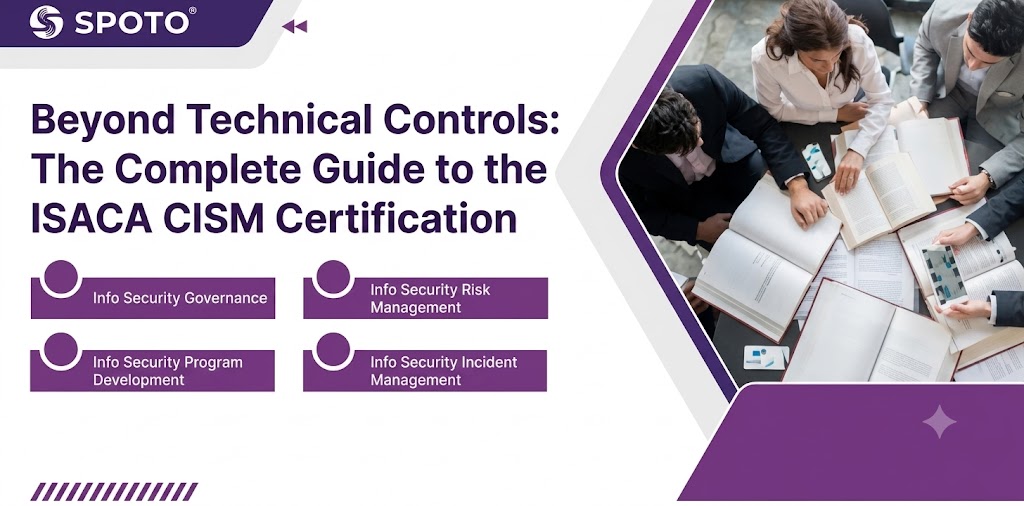
Table of Contents1. What is CISM Certification?2. Benefits of Having CISM Certification3. Details of the CISM CertificationWhat Are the Qualifications to Get a CISM Certification?5. Similar Certifications to CISM Certification Building strong cybersecurity defenses isn't just about deploying firewalls or patching software. It requires aligning security strategies with business goals, managing enterprise risk, and ensuring fast recovery when incidents occur. For IT professionals aiming to step into security leadership, the Certified Information Security Manager (CISM) credential serves as a standard for managerial competence. Here is a clear look at what the CISM certification entails, its career benefits, exam details, qualification requirements, and related industry credentials. 1. What is CISM Certification? The CISM (Certified Information Security Manager) is an advanced management-level certification issued by ISACA, a global professional association focused on IT governance, risk, and cybersecurity. Unlike hands-on technical certifications that evaluate how to configure security tools or write scripts, CISM focuses on how to manage, design, oversee, and assess an enterprise security program. The certification content is updated regularly by ISACA to reflect modern operational realities, including cloud security governance, zero-trust frameworks, data privacy regulations, and supply chain risk management. Holding a CISM proves that an engineer or administrator can transition into management and make security decisions that support overall business objectives. 2. Benefits of Having CISM Certification Earning the CISM certification demonstrates that you possess a management mindset rather than just technical knowledge. It shows employers you know how to talk to board members and executives about risk in business terms. Key advantages of holding a CISM include: Executive Credibility: It is widely recognized as a benchmark credential for roles like Information Security Manager, Security Director, and Chief Information Security Officer (CISO). Global Portability: Because CISM focuses on universal governance and risk management principles, the certification is respected in over 180 countries across finance, healthcare, government, and technology sectors. Higher Earning Potential: Employers place a high value on professionals who can bridge the gap between technical teams and executive leadership. Industry data shows CISM holders frequently command annual salaries between $135,000 and $165,000+, depending on location and experience. Career Progression: It serves as a clear stepping stone for experienced technical staff looking to move out of daily ticket queues and into strategic planning and leadership roles. 3. Details of the CISM Certification The CISM exam lasts 240 minutes (4 hours) and consists of 150 multiple-choice questions. Candidates can take the test either via online remote proctoring or at an authorized PSI testing center. Final scores are converted to a scaled range between 200 and 800 points, with 450 points required to pass. The exam content is distributed across four core management domains: Information Security Governance (17%): Designing an information security strategy that aligns with organizational goals, legal requirements, and enterprise governance frameworks. Information Risk Management (20%): Identifying vulnerabilities, calculating potential business impact, and implementing risk treatment options to keep risk within acceptable limits. Information Security Program Development and Management (33%): Designing, building, and operating the security infrastructure, policy frameworks, and team workflows needed to execute the security strategy. Information Security Incident Management (30%): Establishing response plans, managing containment efforts, and ensuring business continuity when security breaches occur. The CISM exam relies heavily on scenario-based questions. Instead of testing memorized definitions, questions put candidates in managerial scenarios where they must choose the best or first action to take from an executive perspective. What Are the Qualifications to Get a CISM Certification? Earning the official CISM credential requires completing a three-part process: (1) Pass the Certification Assessment You must register for and pass the 150-question CISM exam. Preparing for the test involves reviewing ISACA's core domains and practicing scenario-based decision-making. Working through updated practice question pools—such as the CISM prep resources offered by SPOTO—helps candidates get used to ISACA's managerial question logic and manage their pacing during the 4-hour exam (2) Verify Work Experience Passing the exam grants you exam-passed status, but to hold the full certification, you must verify at least 5 years of professional work experience in information security management within the 10 years prior to application. At least 3 of those years must be in two or more of the core CISM domains. Candidates can waive up to 2 years of the general experience requirement if they hold related credentials (like CISA or CISSP) or a relevant master's degree. (3) Maintain the Certification CISM certification is maintained on a 3-year cycle. To stay active, credential holders must agree to ISACA's Code of Professional Ethics, pay an annual maintenance fee, and earn a minimum of 20 Continuing Professional Education (CPE) credits per year (with a total of 120 CPEs required over the 3-year cycle). 5. Similar Certifications to CISM Certification Depending on your specific career goals in security and IT management, several related certifications cover adjacent skill sets: Certified Information Systems Security Professional (CISSP): Offered by ISC2, covering a broader mix of deep technical security domains along with security management. Certified in Risk and Information Systems Control (CRISC): Also issued by ISACA, focusing specifically on enterprise IT risk identification and control implementation. Certified Chief Information Security Officer (CCISO): Managed by EC-Council, designed specifically for top-tier executive leadership and C-suite management strategies. Certified Information Systems Auditor (CISA): ISACA's flagship qualification for auditing, controlling, and monitoring enterprise IT systems. -
- 691
- SPOTO 2
- 2026-06-24 10:33
Table of Contents1. The Testing Framework: Formats, Clocks, and Mechanics2. The 2026 Blueprint: The Massive Transition to 4 Domains3. Developing the Privacy Engineer Mindset4. Eliminating the Preparation Guesswork For a long time, data privacy was treated as a legal problem. Companies hired compliance lawyers to draft massive, complex terms of service agreements, privacy policies, and cookie consent banners. The technical team's job was simply to copy and paste those legal texts onto the website and hope for the best. But a legal document cannot stop an unencrypted Amazon S3 bucket from leaking millions of customer records. A text policy cannot prevent an application programming interface (API) from exposing personally identifiable information (PII) to unauthorized third-party developers. And it certainly cannot manage the complex data retention limits required when feeding enterprise data into machine learning pipelines. Modern organizations have realized that privacy cannot just be declared on paper; it must be compiled into code, integrated into system architectures, and embedded directly into database schemas. This operational reality is why ISACA created the Certified Data Privacy Solutions Engineer (CDPSE) certification. It bridges the deep chasm between legal compliance and practical, hands-on engineering, validating professionals who know how to build privacy frameworks directly into enterprise systems. 1. The Testing Framework: Formats, Clocks, and Mechanics Unlike many vendor-focused IT certifications, the CDPSE exam does not carry a specific, alphanumeric exam code. It is referred to globally simply as the ISACA CDPSE Examination. When you book your seat—either at an authorized physical testing center or via a secure online proctored environment—you are entering a technical validation sandbox designed to evaluate your practical implementation judgment. The exam parameters require strict time and pacing management: The Clock: You are given exactly 3.5 hours (210 minutes) to complete the evaluation. The Question Volume: The exam consists of 120 multiple-choice questions. The Style: These are highly situational, scenario-driven questions. You will not be asked to mindlessly define terms. Instead, you will be placed in real-world scenarios, such as managing a data flow mapping conflict across cross-border cloud environments or selecting an encryption methodology for sensitive data at rest inside a modern data warehouse. The Metric: Passing requires achieving a scaled score of 450 or higher on a 200–800 grading spectrum. 2. The 2026 Blueprint: The Massive Transition to 4 Domains If you are preparing for the CDPSE using training frameworks or study guides designed during the early days of the certification, you will face an unexpected hurdle at the testing center. ISACA officially retired its old three-domain model (which focused loosely on governance, architecture, and lifecycle) and completely overhauled the curriculum into a four-domain Job Practice outline. This update reflects the complex reality of managing modern cloud-native architectures, microservices, and automated artificial intelligence data pipelines. The current exam splits your testing footprint across four distinct, highly technical pillars. Domain 1: Privacy Governance (20%) Governance sets the strategic foundation. This domain checks your ability to identify internal and external privacy requirements, align organizational systems with international regulations (such as GDPR or CCPA), and establish clear data governance documentation. You will face questions tracking how to define technical roles and responsibilities across a distributed data infrastructure, manage vendor or supply chain privacy liabilities, and handle the notification procedures required during a live privacy incident. Domain 2: Privacy Risk Management and Compliance (18%) Carved out into its own dedicated domain to match the aggressive global regulatory environment, this section evaluates your skill in performing Privacy Impact Assessments (PIAs) and structural threat modeling. You must know how to identify specific privacy vulnerabilities within an application's design, evaluate the privacy risk posture of external software-as-a-service (SaaS) providers, and build continuous monitoring metrics that prove to external auditors that your data protection controls are actively functioning. Domain 3: Data Life Cycle Management (23%) Data is a dynamic asset that moves constantly. This domain focuses on the mechanics of data from the moment it is collected to the moment it is permanently destroyed. You must demonstrate complete mastery of data inventorying, structural classification schemes, and dataflow diagramming. A significant emphasis is placed on data minimization techniques and the complexities of modern data analytics. You need to prove you understand how to implement privacy controls when data is aggregated, processed inside an enterprise data warehouse, or utilized for machine learning model training. Domain 4: Privacy Engineering (39%) Commanding the massive lion's share of the entire exam, this domain is where the certification truly proves its technical engineering focus. Replacing the legacy "Privacy Architecture" domain, Privacy Engineering tests your ability to implement practical technical controls across modern tech stacks. You will be evaluated on your command of secure development lifecycles (SDLC), API security configurations, and cloud-native services. Expect rigorous questions regarding the deployment of privacy-enhancing technologies (PETs), identity and access management (IAM) matrices, database hardening, advanced hashing techniques, and the implementation of robust encryption protocols for data both in transit and at rest. 3. Developing the Privacy Engineer Mindset The primary reason technical professionals stub their toes on the CDPSE exam is failing to distinguish between pure cybersecurity and dedicated data privacy. Cybersecurity is focused on protecting data from unauthorized external access—keeping the bad actors out of the network. Data privacy engineering, however, focuses on ensuring that even when authorized systems and users are interacting with data, they are doing so in a way that respects user consent, limits retention, minimizes data exposure, and adheres strictly to specific lawful purposes. To pass the CDPSE, your mindset must expand beyond firewall configurations and intrusion prevention. You must learn to look at an application architecture and ask: Are we collecting more data than necessary? Are we tracking data lineage correctly across our cloud platforms? Do our automated systems mask or anonymize PII before it reaches our analytics teams? 4. Eliminating the Preparation Guesswork Because the modern CDPSE examination relies so heavily on parsing complex engineering scenarios and matching them against the newly implemented four-domain objectives, attempting to study through passive reading or outdated materials can create significant blind spots. Surviving the 210-minute testing window requires hands-on familiarity with how privacy-by-design principles function within real-world IT infrastructure. When you are ready to streamline your study path and ensure your preparation matches the live testing environment, using professional, targeted training architectures can completely transform your approach. SPOTO provides highly accurate exam practice simulations, updated review modules, and verified preparation frameworks designed to mirror ISACA's modern four-domain parameters. By leveraging these precise tools to test your pacing, refine your situational judgment, and validate your privacy engineering logic before scheduling your official test day, you can approach the testing center with total confidence and earn your CDPSE credential on your very first attempt. -
- 700
- SPOTO 2
- 2026-06-24 10:23
Table of Contents1. The Mechanical Blueprint: Inside the CGEIT Testing Sandbox2. Deconstructing the Four Governance Pillars3. The Core Philosophy: Developing the CGEIT Mindset4. Streamlining Your Path to Executive Validation Think about the most spectacular enterprise technology failures you have seen over the last few years. More often than not, those disasters didn't happen because an engineer wrote bad code or a firewall failed to block a packet. They happened because an organization spent tens of millions of dollars on a massive digital transformation project that had absolutely no alignment with its actual business objectives. They built a brilliant technical solution for a problem the company didn't actually have. When you operate at the upper echelons of corporate technology—as a CIO, CTO, enterprise architect, or governance director—your value isn't measured by your ability to manage day-to-day operations. It is measured by your ability to ensure that every single dollar invested in technology actively drives enterprise value, manages systemic risk, and optimizes corporate resources. While certifications like CISM or CISSP prove you can defend an infrastructure, ISACA's Certified in the Governance of Enterprise IT (CGEIT) proves you can steer the entire corporate ship. It is a highly specialized, framework-agnostic credential designed exclusively for those who advise, manage, and oversee the strategic direction of enterprise IT. 1. The Mechanical Blueprint: Inside the CGEIT Testing Sandbox Passing the CGEIT examination requires a highly disciplined approach to managing both your time and your executive perspective. Because this exam targets seasoned professionals who already possess significant advisory and management experience, the testing parameters are designed to evaluate strategic endurance. The formal examination structure consists of 150 multiple-choice questions, and you are given exactly 4 hours (240 minutes) to complete the session. The testing environment is computer-based, available through authorized physical testing facilities or via secure online remote proctoring. The primary trick of the CGEIT exam isn't technical complexity; it is situational nuance. You will face scenario-heavy questions where an enterprise is navigating a complex corporate merger, experiencing structural friction between the board and the IT department, or struggling to prioritize a portfolio of competing tech investments. Your goal is to select the answer that represents optimal governance framework logic, rather than a quick operational fix. 2. Deconstructing the Four Governance Pillars To achieve a passing score, you must align your preparation with ISACA's four core job practice domains. Each domain evaluates your capacity to set direction, define decision rights, manage assets, and measure real-world performance. Domain 1: Governance of Enterprise IT This domain forms the absolute baseline of the certification. It focuses entirely on defining, establishing, and maintaining a robust, sustainable governance framework that aligns seamlessly with the enterprise's broader mission and vision. Testing within this space evaluates your knowledge of major governance structures, organizational culture, business ethics, and legal or regulatory compliance rules. You must demonstrate a clear understanding of how to set up decision-making hierarchies, assign clear accountability patterns, and map out information architectures that ensure transparent data ownership throughout the entire corporate asset lifecycle. Domain 2: IT Resources An enterprise cannot execute its strategy without resources, but managing those resources effectively at scale is incredibly difficult. This pillar focuses on both resource planning and resource optimization. The curriculum tests your ability to design smart sourcing strategies (such as balancing insourcing vs. cloud outsourcing options), execute resource capacity planning, and manage asset lifecycles from acquisition to retirement. It also places a strong emphasis on the human element, requiring you to understand how to assess human resource competencies and effectively manage contracted service relationships and vendor service-level agreements (SLAs). Domain 3: Benefits Realization Technology investments are fundamentally business cases that promise future value. This domain evaluates how an enterprise systematically tracks and confirms that those promises are actually fulfilled. The testing criteria place a high premium on performance management, continuous governance monitoring, and reporting metrics. You must prove you can construct comprehensive business cases, evaluate IT-enabled investments using strict benefit evaluation methods, and deploy balanced scorecards or performance metrics that communicate actual value to executive leadership rather than just tracking superficial technical activities. Domain 4: Risk Optimization Every strategic technical leap introduces corporate exposure. This final domain tests your capacity to identify, analyze, mitigate, and monitor IT-related risks within a broader Enterprise Risk Management (ERM) framework. The exam requires deep familiarity with risk strategy mechanics—such as establishing an organization's precise risk appetite and risk tolerance boundaries. You will face questions designed to test your mastery of risk management lifecycles, risk assessment methodologies, and continuous operational monitoring to ensure that the controls protecting your infrastructure do not create unnecessary operational friction. 3. The Core Philosophy: Developing the CGEIT Mindset The secret to conquering the CGEIT on your first attempt lies in understanding what the exam rewards. This is not a delivery or implementation certification. It rewards three foundational architectural principles: Traceability: Every technical control, investment portfolio, and performance measure must link directly backward to a corporate strategic goal. If a project cannot trace its lineage to business value, it shouldn't exist in the enterprise ecosystem. Separation of Duties: Governance demands clear boundaries. The exam strictly enforces the concept that the person or team responsible for building or executing a system should not be the same entity that approves or audits it. Evidence Over Intent: Policies written down in a corporate employee manual mean absolutely nothing unless there are verifiable decision logs, regular portfolio reviews, and clear operational outcomes that prove those policies are active. When answering questions, always view the problem through the lens of a board member or an external strategic consultant. The correct choice is never the one that suggests a temporary patch or an isolated engineering workaround; it is the choice that establishes systemic oversight, clarifies accountability, and protects long-term enterprise value. 4. Streamlining Your Path to Executive Validation Because the CGEIT deals almost entirely with abstract governance concepts, framework mapping (such as aligning COBIT 2019, ISO/IEC 38500, and ITIL principles), and complex situational judgment, studying by simply memorizing definitions is an easy way to experience exam failure. You need to practice dissecting high-level corporate scenarios, identifying the hidden business constraints in the questions, and refining your executive pacing under a strict four-hour clock. When you are ready to eliminate the ambiguity from your study routine and ensure your preparation mirrors the active testing environment, utilizing targeted, professional educational frameworks can completely transform your preparation trajectory. SPOTO offers highly accurate exam practice simulations, up-to-date review architectures, and verified evaluation questions designed specifically to align with ISACA's rigorous testing criteria. By leveraging these real-world preparation tools to test your domain endurance and validate your strategic governance logic before your official test date, you can approach the testing center with complete clarity, clear the 150-question matrix smoothly, and claim your globally recognized expert CGEIT status on your very first try. -
- 693
- SPOTO 2
- 2026-06-23 10:32
Table of Contents1. The Logistics: What You're Up Against2. The 2026 Shift: AI, Quantum, and the New Blueprint3. A Realistic Look at the Four Updated Domains4. The Secret to Passing: Adjusting Your Mindset5. Cutting Down the Study Grind If you've spent your career in the technical trenches, you know the drill. You patch the servers, secure the endpoints, and watch the logs. You feel like a hero because your uptime is perfect. But then you sit in a meeting with company executives, and the conversation completely changes. They aren't asking about your firewall rules or your bash scripts. They're talking about liability, insurance premiums, regulatory fines, and risk appetite. That disconnect is exactly where a lot of great IT careers stall out. Companies don't just need people who can configure a secure system anymore; they need professionals who can bridge the gap between technical vulnerabilities and business survival. If you want to prove you can think like an executive and protect an entire organization's strategy, the Certified in Risk and Information Systems Control (CRISC) certification by ISACA is the undisputed heavyweight title. It shifts you out of the server room and gives you a seat at the decision-making table. 1. The Logistics: What You're Up Against Before diving into the strategy, let's look at the actual parameters of the test. The CRISC exam isn't something you can walk into and pass on raw technical intuition alone. The Setup: You get exactly four hours (240 minutes) to tackle 150 multiple-choice questions. The Reality: These aren't simple vocabulary recall questions. ISACA loves situational scenarios. You'll be dropped into a hypothetical mess—like a vendor failing an audit or a new cloud database causing a privacy scare—and you have to pick the best business-aligned answer from four options that all look somewhat reasonable. 2. The 2026 Shift: AI, Quantum, and the New Blueprint The tech world doesn't stand still, and neither does the exam. ISACA rolled out a massive Job Practice Update that completely dictates how the exam is scored and tested. If you are using study guides or practice banks from a couple of years ago, you are preparing for a test that doesn't exist anymore. The current blueprint reflects the chaotic reality of modern enterprise tech. For the first time, the exam explicitly tests you on Artificial Intelligence and Large Language Model (LLM) risks. You need to understand the dark side of corporate ChatGPT-style integrations, from data leakage during model training to the ethical implications of automated decision-making. On top of that, Quantum Computing Threats have officially entered the syllabus. The exam expects you to know how quantum technology impacts current cryptographic standards and how an enterprise can future-proof its security posture before today's encryption becomes obsolete. 3. A Realistic Look at the Four Updated Domains To organize your study time effectively, you need to understand the four core pillars of the updated outline and how ISACA weighs them. (1) Governance (26%) Think of governance as setting up the guardrails for the entire company. This section isn't about configuring tools; it's about alignment. You'll be tested on your understanding of corporate strategy, enterprise risk management (ERM) frameworks, and organizational culture. You need to know how to write security policies that actually support business growth instead of suffocating operations under mountains of bureaucratic red tape. (2) Risk Assessment (22% of the exam—Shifted Up) Because the threat landscape has exploded with AI and cloud microservices, ISACA bumped the weight of this domain up to 22%. This is where you learn to spot the landmines. You'll need to demonstrate total fluency in threat modeling, vulnerability analysis, and building realistic risk scenarios. A major focus here is understanding the difference between inherent risk (the raw danger before you do anything) and residual risk (the danger that remains after you've put your controls in place). (3) Risk Response and Reporting (32%) This is the most critical part of the test. Spotting a risk is useless if you don't know what to do with it. You have to master the four classic responses: mitigating the risk, avoiding it entirely, transferring it (like buying cyber insurance), or consciously accepting it. You'll also face heavy testing on Key Risk Indicators (KRIs). Executive boards don't want a 200-page vulnerability report; they want clean, data-driven metrics that tell them exactly where the company's risk profile stands today. (4) Technology and Security (20%) This domain was trimmed slightly down to 20% to keep the focus on pure risk management, but it remains the technical anchor of the credential. It checks whether you actually understand the systems you're evaluating. Expect questions covering data lifecycle management, system development lifecycles (SDLC), change management, and the baseline security controls needed to defend hybrid cloud frameworks. 4. The Secret to Passing: Adjusting Your Mindset The biggest mistake technical professionals make when taking the CRISC is answering questions like a systems administrator. If a question tells you that a critical business system has a high-severity vulnerability, an engineer's immediate instinct is to take the system offline and fix it. On the CRISC exam, that is often the wrong answer. Taking a core revenue-generating system offline without calculating the financial fallout might hurt the business worse than the vulnerability itself. To pass this test, you have to look at every problem through the lens of a business manager. Your first step is always to gather data, evaluate the potential financial and operational impact, consult the organization's stated risk tolerance, and present balanced options to the actual business owners. The correct choice is the one that balances security with operational continuity. 5. Cutting Down the Study Grind Because the current CRISC exam deals with highly nuanced, situational logic, trying to pass by just reading a 500-page theory manual cover-to-cover is a recipe for a very frustrating test day. You have to practice dissecting real scenario questions until you can spot the subtle tricks ISACA hides in the phrasing. If you want to save yourself a hundred hours of aimless reading and guarantee you're studying the exact material running on the live 2026 exam, keeping your prep aligned with targeted, updated study frameworks makes all the difference. SPOTO offers highly accurate, real-world mock exams and verified practice questions that match the post-update blueprint perfectly. Using these resources allows you to practice pacing your four-hour window, refine your risk-manager mindset, and walk into the testing center with the confidence to clear the hurdle on your very first attempt.